

It’s one of the financial realities every person has to deal with at some point, regardless of whether the debt is a student loan, a credit card balance, a medical expense, or even an auto loan. While borrowing money can be a common and essential part of life, how you handle the debt you take on has an immediate and long-lasting impact on your credit rating. Knowing this is crucial to protect you from financial ruin, qualify interest rates, and avoid the tale of debt spiral that can last many years.
We’ll go over How Debt Affects Your Credit Score, the particular aspects that are most important and the best steps you can take in the event that you’re struggling. We’ll also discuss the ways debt relief services, such as UltraDebt Relief, will help individuals regain control of their money and also build their credit in the course of time.
What Is a Credit Score, and Why Does It Matter?
The credit score can be described as a 3-digit number, which typically ranges between 300 and 850, and indicates how likely you will be able to pay back any money you have borrowed. Insurance companies, landlords, lenders, and even a few employers rely on this number to determine your financial credibility. The better your score, the more reliable your profile appears to those who make decisions on whether to give credit to you — and under what terms.
Credit scores aren’t only an amount that decides whether you are approved for loans. It affects:
- The interest rate that you can get for mortgages, credit cards, and auto loans.
- The ability to lease an apartment
- In many states, insurance premiums are high.
- Utility deposits
- A few background checks for employment are required, especially in finance-related positions.
Since so much is dependent on this one number, it’s important to understand how debt—and how you handle it—affects it.
The Five Factors That Determine Your Debt Affects Your Credit Score
Models for credit scoring, such as FICO and VantageScore, use different categories that are weighted. Although the exact formulas are exclusive, the overall structure is this:
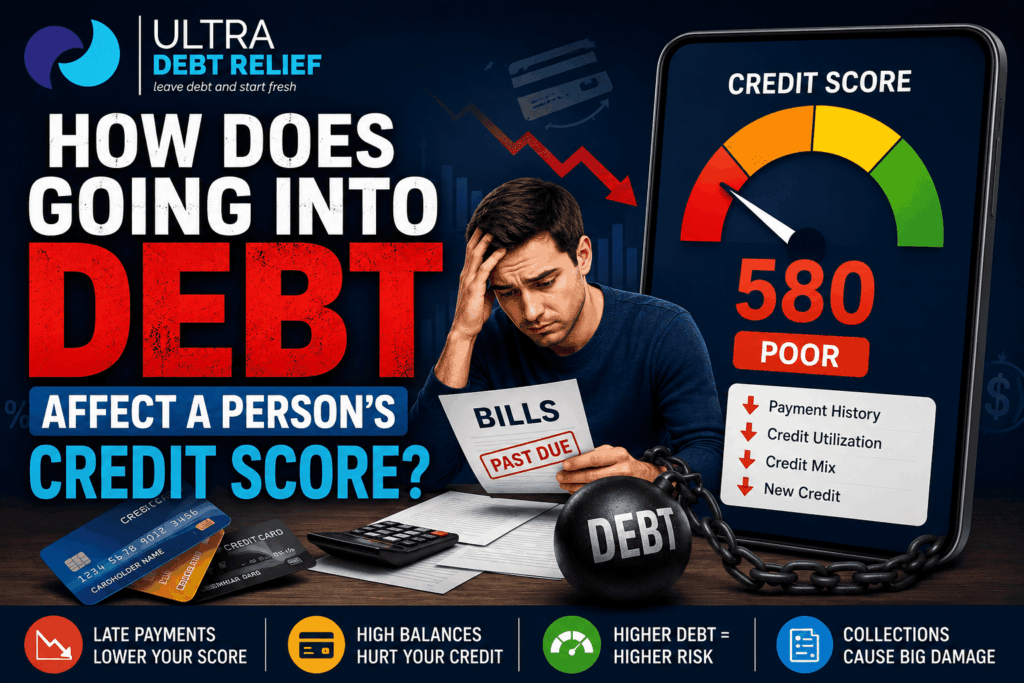
1. Payment History (about 35%): This is the most important element. It shows whether you’ve been able to pay your bills on time. A single late payment can result in a significant drop, and the negative impact can get worse when a balance remains not paid, especially when it is at the 30-, 60, or 90-day late threshold.
2. Credit Utilization (about 30%) This is how much available credit you’re making use of. When you’ve got a credit limit of $10,000 across your cards, and you’re carrying a balance of $7,000, the utilization ratio will be 70%. This is considered to be high and could negatively impact your score. Experts recommend maintaining utilization levels at or below 30% and, in the ideal case, under 10% for most healthy scores.
3. Length of Credit History (about 15%) This is one reason why closing old credit cards, even ones that you don’t utilize frequently, may backfire since it reduces the average age of your account.
4. Credit Mix (about 10%) Lenders want to ensure that you are responsible in managing different kinds of credit, including credit cards that revolve (credit cards) or installment loans (auto mortgages, loans, and individual loans).
5. New Credit Inquiries (about 10%) Each time you apply for new credit and you are approved, a “hard inquiry” is placed on your credit report. It could result in a slight short-term dip in your rating. Multiple applications within a brief time frame can indicate risk to lenders.
How Debt Specifically Affects Each of These Factors
Now let’s connect the dots between debt itself and these five factors.
How does debt settlement affect credit score?
Missed or Late Payments
If debt becomes too much to handle, the likelihood of missed payments is the first indication of trouble. A single 30-day late payment can lower a credit score by anywhere from 60 to 110 points, as per statistics frequently cited from credit reporting agencies. The harm is exacerbated when the debt is referred to collections or repaid, or if the negative marks could be on your credit report for up to seven years.
Rising Credit Utilization
As debt accumulates—particularly credit card debt—your utilization ratio climbs. Even if you’re making the minimum payment on time, a high utilization can lower your score, as it indicates to your lenders that you might be overextended.
Debt Settlement and Collections
If a debt is not paid for a long time, creditors could sell the debt to a collection agency or agree to a how does debt settlement affect credit score that is less than the total amount owed. Both of these events are reported on your credit file and can drastically lower your score, often by more than 100 points in accordance with your beginning score and your overall credit profile.
Bankruptcy
In extreme cases, insolvent debt can force individuals to declare bankruptcy. While bankruptcy can provide the opportunity for a fresh start by clearing certain debts, it stays visible on credit reports for seven to 10 years, making it difficult to get credit in the near future.
The Ripple Effect on New Credit
If your credit score falls because of debt-related issues, this makes it more difficult and more costly to obtain loans. Creditors view you as more risk, and therefore offer higher interest rates, which could trap you in a vicious cycle of debt becomes more costly for you to repay.
The Emotional and Practical Toll of Debt
It’s important to realize that debt isn’t just a number issue; it’s stress-related. Financial stress is among the most frequently mentioned sources of anxiety. The fear of not knowing the best way to pay off debt can have a negative impact on sleep relationships, as well as general well-being. Understanding the human aspect of debt is crucial as it helps explain why so many people delay taking action even when they realize that it is affecting their credit.
The positive side is the fact that your credit score aren’t forever based judgments, but rather an ongoing reflection of your past financial habits. So, if you have the right strategy, it’s possible to repair the damage and restore your credit score over time.
Steps to Protect (or Rebuild) Your Credit Score
Make sure you pay punctually, each time. Since payment history is the most important factor, make sure that on-time payments are prioritized—even minimum ones should be the first defense.
Reduce your utilization rate. Paying down balances at a slow pace could result in a significant score improvement in a single session or two.
Don’t close old accounts prematurely. Keeping older accounts open can help maintain your credit score.
Stop new credit applications. Space out applications for new credit in order to avoid multiple hard inquiries within an unintentional time.
Check your credit report on a regular basis. Errors on credit reports are more prevalent than most people think and arguing with incorrect information may result in rapid score increases.
Take into consideration professional debt relief assistance. If your debt is becoming difficult to manage by yourself.
Why UltraDebt Relief Helps in Debt Relief
For many the debt problem doesn’t get out of control due to poor decision-making. It is caused by an unexpected job loss, a medical emergency, a rise in income, or the effect of compounding interest on balances that seemed not a problem at first, but then grew in time. If debt gets to a point that minimum payments don’t suffice the debt, professional assistance can make a significant difference, and that’s where UltraDebt Relief positions itself as an option to consider.
A Structured, Personalized Approach Rather than offering a one-size-fits-all solution, UltraDebt Relief typically starts by evaluating a person’s full financial picture — total debt load, income, monthly obligations, and the types of creditors involved. This allows for a tailored strategy, whether that’s debt settlement negotiation, a structured repayment plan, or budgeting guidance designed to stop the bleeding before it gets worse.
Negotiating on the Client’s Behalf A single of the most beneficial aspects when working through a debt reduction agency is the negotiation component. The majority of creditors are more willing to collaborate through a third-party provider rather instead of working directly with an individual as debt relief organizations frequently negotiate settlements and know what lenders are actually prepared to take. This can lead to reduced amounts, waived fees or more attainable payments — results which aren’t easy for an individual to obtain on their own.
Reducing the Stress of Multiple Creditors When someone is owed money by multiple creditors and is unable to keep track of the due deadlines, the interest rate and settlement options can be stressful. A system of consolidation that has one person handles negotiations and communication across accounts — eases the burden on the brain and lowers the possibility of late payments, which could lead to harm credit.
A Path Toward Rebuilding Credit While settling debt is a possibility to result in a temporary drop in credit scores but the ultimate goal of programs like UltraDebt Relief is to help clients get rid of debt faster than they would on by themselves, break the cycle of missed and interest payments, and lay an ideal basis for rebuilding credit after the debt is settled. For many, having a lower credit score now in exchange for being debt-free in just a few years is a good deal particularly when compared with the possibility of spending 10 years or more of struggling with high-interest debts that are revolving.
Education and Ongoing Support Beyond negotiations A good debt relief service also offers financial education, which helps clients to understand how to budget and how to avoid getting into debt again and make intelligent decisions about their credit going forward. This comprehensive support is typically the main difference that separates a temporary solution from a long-lasting financial recovery.
Final Thoughts
Credit scores and debt are tightly interwoven. Every late payment, every increasing balance, and each collection account tells a tale that creditors read carefully. However, debt doesn’t need to be the sole determinant of your financial situation. By establishing a consistent routine and, when required, expert assistance from services such as UltraDebt Relief — it’s completely possible to transition from a state of financial stress towards a place of peace, and possibly solid credit health.
If you’re dealing with debt that’s impossible to manage The most crucial step is to simply by reviewing your debts and understand where you stand and consider the options you have such as a self-directed payment plan or using a dedicated debt relief company that will represent you on your behalf.
Table of Contents
How much does debt actually hurt my credit score?
This all depends on the kind of debt issue. One late payment could lower a credit score by anywhere from 60 to 110 points. The use of credit cards to the max (high utilization) could cost you 20-50 points, even without a late payment. The collection process and the charge-offs or bankruptcy can cause the most severe drops, sometimes 100+ points, and remain on your credit report for 7-10 years.
2. Does carrying debt always lower my credit score?
Not necessarily. Carrying debt responsibly—making on-time payments and keeping balances low relative to your limits—can actually help your score by showing lenders you can manage credit. It’s mismanaged debt (missed payments, high utilization, collections) that causes damage, not debt itself.
3. How long does debt stay on my credit report?
The majority of negative things, like collections, late payments, and charge-offs, remain for a period of about 7 years. Chapter 7 bankruptcy can stay for up to 10 years. The effect on your score is diminished over time, and even after the bankruptcy is over in the event that you create a positive credit history with it.
4. What’s the fastest way to improve my score if I’m in debt?
I’m in the process of paying off the middle of a debt. Paying down the balances on credit cards to lower your utilization ratio is likely to result in the fastest evident improvement within a couple of billing cycles. Recovering the missed payments and contesting errors in reports are the next levers to use.
5. Will debt settlement hurt my credit score?
Usually in the short term. Settlement of a debt that is less than what is owed will usually be described in the form of “settled” rather than “paid in full,” which could lower your credit score for a short period of time. For those who are experiencing problems with missed payments or rising balances, settling will not cause more damage in the long run than defaulting and also allows you to begin rebuilding faster.