

Yes, in many cases you can use a credit card for a car down payment, but it’s not always allowed and it’s rarely the cheapest option. Many dealerships accept cards for part of the down payment, usually with a spending cap and sometimes a processing fee. Some auto lenders also won’t count borrowed money toward your down payment. If you pay the card off quickly, it can work. If you carry the balance, the interest can add hundreds of dollars to the real cost of the car.
Key takeaways
- Most dealers accept a credit card for a car down payment, but many limit how much you can charge.
- Some lenders don’t allow a down payment funded by borrowed money, so check before you pay.
- Cash advances are usually the most expensive way to cover a down payment.
- A large card charge can raise your credit utilization and temporarily lower your credit score.
- Trade-in equity, savings, rebates, and credit union loans are often cheaper alternatives to using a credit card for a car down payment.
Putting a down payment on a card can feel like the easy fix when you need a car and don’t have the cash. Sometimes using a credit card for a car down payment works out fine. Other times it quietly adds interest and makes the loan harder to get approved. Here’s how it works, so you can decide before you swipe..
Do car dealerships accept credit cards for a down payment?
Most dealerships in the U.S. accept credit cards in some form, but that doesn’t mean they’ll take one for your entire down payment. Card processing costs dealers money, usually a few percent of every transaction. On a big purchase like a car, those fees add up quickly.
Because of that, you’ll usually run into one of these situations:
- A spending cap. Many dealers allow only a few thousand dollars on a card. The limit varies by dealership, so ask before you go.
- A surcharge. Some dealers pass the processing fee on to you, often 2% to 4%.
- Cash or check only. Some dealers won’t take a card at all for a down payment, especially on used cars.
A private seller is a different story. Individuals rarely accept cards, so you’d probably need a cash advance or a payment app, and both can get expensive.
Will your auto lender allow a credit card down payment?
This is where many buyers get tripped up. Even if the dealer is happy to take your card, the company financing your car may have its own rules about using a credit card for a car down payment.
Lenders want to see that you have real money invested in the car. If your down payment comes from a credit card, you’ve borrowed to make it. That adds to your total debt and raises your debt-to-income ratio, which lenders look at closely.
Some lenders ask where your down payment came from. Many are fine with a modest amount on a credit card for a car down payment. Others won’t count borrowed funds at all, and almost none like cash advances. If your application gets flagged late in the process, you could end up scrambling for cash at the worst possible time.
The safest move is to ask the dealer’s finance office and your lender directly: “Can I put part of my down payment on a credit card, and is there a limit?”
How much does it really cost to pay a car down payment with a credit card?
Say you put $3,000 on a card with a 22% APR and pay it off slowly over two years. You could pay several hundred dollars in interest on top of the $3,000. You’d also pay interest on the car loan itself, so you’re effectively borrowing twice for the same car.
Here’s what else to weigh:
Interest rates. Credit card APRs are often well above 20%, which is far higher than most auto loan rates. A down payment on a card can cost more than the loan it’s helping you get.
Credit utilization. This is how much of your available credit you’re using. A big charge on one card can push your utilization up and lower your credit score right when you’re applying for an auto loan.
Cash advance fees. If the dealer won’t take a card, you might think about a cash advance. That usually means a fee of 3% to 5% plus a higher interest rate that starts the day you take the money, with no grace period. It’s almost always the most expensive way to pay.
A tighter monthly budget. You’ll have a car payment and a credit card payment at the same time. If money is already tight, that gets uncomfortable fast.
When does a credit card down payment make sense?
It isn’t always a bad idea. A card can be reasonable if:
- You can pay the balance off before interest kicks in, or within a month or two.
- You have a card with a 0% introductory APR on purchases and a realistic plan to pay it off before the promotional period ends.
- The dealer accepts the card with no surcharge and your lender is fine with it.
- The rewards you’d earn actually outweigh any fees. That’s uncommon on large purchases once interest is counted.
If you don’t have a clear plan to pay it down quickly, the math usually doesn’t work out.
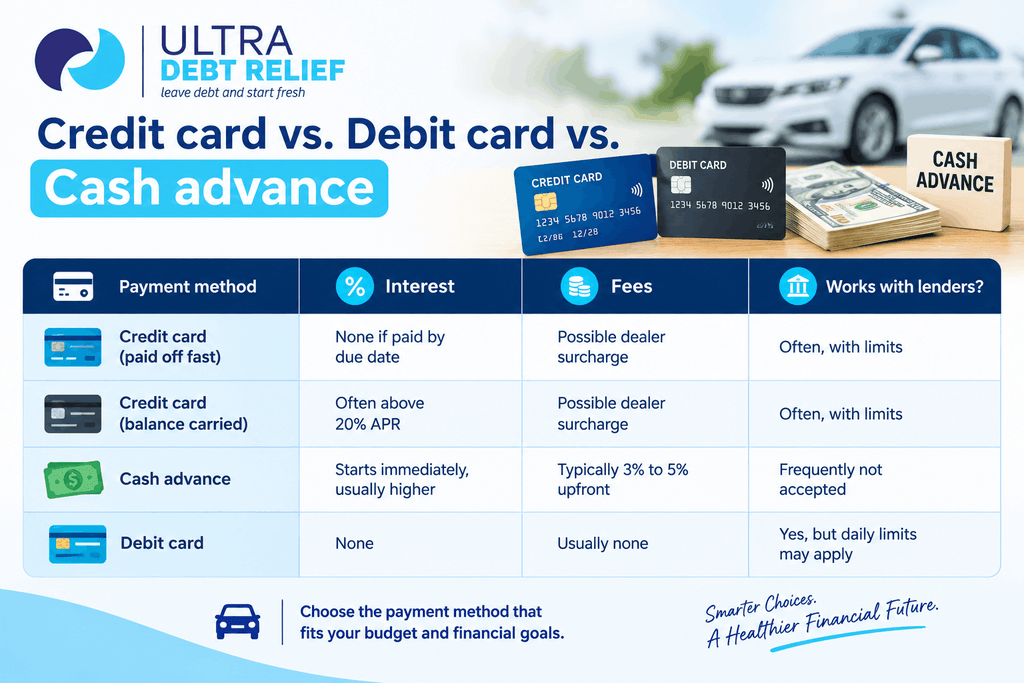
Credit card vs. debit card vs. cash advance
| Payment method | Interest | Fees | Works with lenders? |
| Credit card (paid off fast) | None if paid by due date | Possible dealer surcharge | Often, with limits |
| Credit card (balance carried) | Often above 20% APR | Possible dealer surcharge | Often, with limits |
| Cash advance | Starts immediately, usually higher | Typically 3% to 5% upfront | Frequently not accepted |
| Debit card | None | Usually none | Yes, but daily limits may apply |
Better ways to cover a car down payment
If you’d rather not add to your credit card balances, you have other options:
- Use your trade-in. The equity in your current car can count toward your down payment.
- Save a little longer. Even two or three extra months of saving can reduce your loan amount and your interest.
- Choose a less expensive car. A lower price means a smaller down payment and a smaller loan.
- Ask about rebates and incentives. Some manufacturers offer cash-back deals that can serve as a down payment.
- Talk to a credit union. Credit unions often offer competitive auto loans with flexible down payment rules.
- Look at a low-rate personal loan. If the rate is meaningfully lower than your card’s, it can be cheaper, though some auto lenders still view it as borrowed money.
How much should you put down on a car?
A common guideline is about 10% down on a used car and 20% on a new one. A bigger down payment generally lowers your monthly payment and total interest, and it helps you avoid owing more than the car is worth. What works for you depends on your budget, your credit, and the lender’s requirements.
How UltraDebt Relief Can Help
Putting a car down payment on a credit card is one thing when your balances are low. It’s another when credit card debt is already stretching your budget. High minimum payments, growing interest, and a lower credit score can make a car loan harder to get and more expensive to carry.
We at UltraDebt Relief understand that financial difficulties can affect anyone, including veterans and military families, and that a big purchase like a car can add pressure to an already tight budget.
We help people connect with debt experts who review their financial position and suggest possible debt relief options, including debt settlement options when appropriate. Our mission is to help you find practical solutions that support long-term financial health, so your next big purchase doesn’t come with extra stress.
Frequently asked questions
Can you put a down payment on a car with a credit card?
Often, yes. Many dealerships accept credit cards for part of the down payment, but they commonly set a limit or add a processing fee. Some lenders also restrict borrowed funds, so confirm with both the dealer and your lender.
How much of a car down payment can you put on a credit card?
It depends on the dealer. Some cap card payments at a few thousand dollars, while others allow more. Your card’s credit limit and the dealer’s processing rules both decide the final amount.
Does a credit card down payment hurt your credit score?
It can. A large charge raises your credit utilization, which can lower your score temporarily. That can make it harder to get approved or lead to a higher auto loan rate.
Is it better to use a credit card or a debit card for a down payment?
A debit card avoids interest because you’re using your own money, but daily spending limits can stop you from paying a large amount in one go. A credit card offers more flexibility but costs more if you carry a balance.
Can you use a cash advance for a car down payment?
You can, but it’s usually the costliest route. Cash advances carry upfront fees and high interest that starts right away, and many lenders don’t want a down payment funded this way.
Do lenders know if you used a credit card for your down payment?
They may. Lenders can see your credit card activity when they review your credit, and some ask about the source of your down payment. It’s better to be upfront than to risk a denial later.
Can you split a down payment between cash and a credit card?
Many dealers allow this. You might pay part by card up to their limit and the rest by cash, check, or bank transfer. Just confirm the process before you visit.
What are the alternatives to a credit card for a car down payment?
You can use trade-in equity, savings, manufacturer rebates, a credit union loan, or a lower-priced car. A larger down payment from your own funds usually leads to a better loan.
Should I deal with credit card debt before buying a car?
If your balances are already hard to manage, it’s worth looking at your options first. A new car loan plus a credit card down payment can strain your budget, and lenders may see you as a higher risk.
What should I check before enrolling in a debt relief program?
Read the provider’s terms and conditions closely. Look at the fees, eligibility requirements, and the potential consequences, such as the impact on your credit score, before you register.
Final Thoughts
You can often use a credit card for a car down payment, but being allowed to and it being a smart move are two different things. Check the dealer’s limits and fees, confirm what your lender accepts, and only go this route if you can pay the balance off quickly. If credit card debt is already weighing on you, take a look at your options before taking on a car payment.