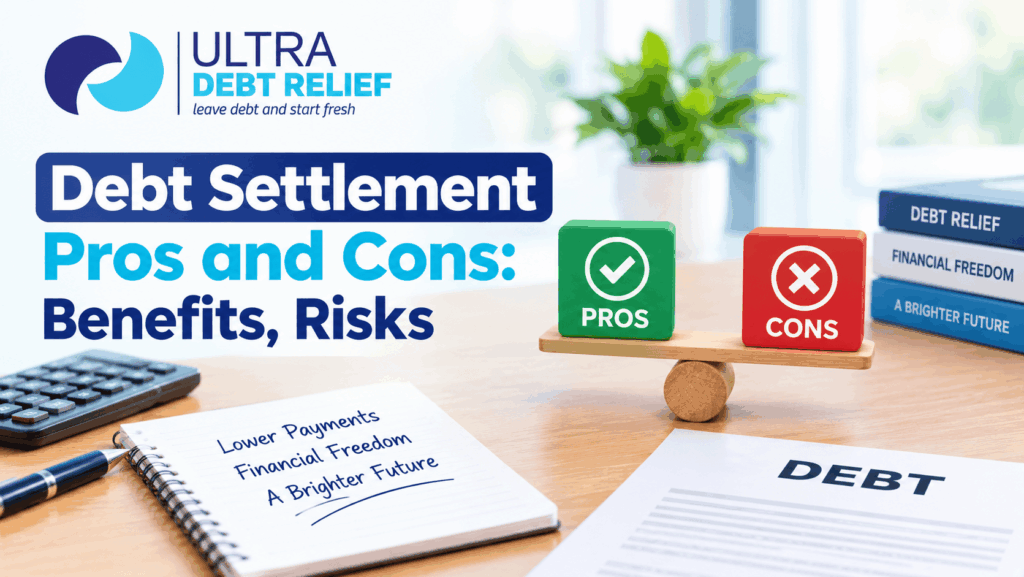

Debt settlement might be a solution for you if you have unsecured debt (such as credit card debt) that you need to resolve for less than what you owe. The biggest risks are the effects on your credit score, the fees, ongoing collection or legal action, and potentially, tax consequences on the forgiven debt. Debt settlement is worthwhile only if you are unable to pay your debts in full and have explored other options such as debt consolidation, a debt management plan, or negotiating with your creditors directly.
Debt settlement might be an option to help some individuals pay off qualifying unsecured debts for less than the entire balance, but it’s not without significant potential drawbacks. We lay out the advantages and disadvantages of debt settlement to help you determine if it’s right for you or not.
Understanding debt settlement. Before you sign up for anything, it’s useful to understand how debt settlement works if you’re facing credit card debt, missed payments, or balances that are increasing. The upside can be paying off some of your debt for less than what you owe. The disadvantages might be to your credit score, collection activity, added interest and fees, and taxes.
We’ll walk through the pros and cons of debt settlement, how settlement can impact your credit, which fees to pay attention to, and the alternatives you should compare first in this guide.
Debt Settlement Pros and Cons
Debt settlement is when you, or a company working for you, discuss with a creditor or a debt collector to settle for less than the debt owed. Creditors do not have to accept offers, and outcomes differ.
| Factor | Potential advantage | Potential disadvantage |
| Debt balance | An eligible debt could be paid off for less than the amount you owe | The creditors might decline to discuss |
| Monthly budget | Debts can be settled for less than the full amount owed | You might need to make contributions before you can settle |
| Credit score | Paying off a debt could benefit your future financial health | Late payments and settled accounts can negatively impact your credit |
| Fees and interest | One good deal can reduce the amount you owe on the debt | Interest, late fees, and program fees can add to the cost of your debt |
| Collections | Once a settlement is finalized, it extinguishes the debt it settles | You can be called or sued until it settles |
| Taxes | Some discharge of debt may be non-taxable | Some forgiven debt may be taxable |
Bottom line: Debt settlement could be an option if you truly cannot pay back your unsecured debts in full. Make sure you understand the potential risks, and compare them to the potential costs of other options such as debt management, debt consolidation, negotiating directly with creditors, or bankruptcy counseling.
What Is Debt Settlement?
Debt settlement is a process in which a borrower negotiates with the creditor or a collection company they owe to agree on an amount that is less than the borrower owes. It is a way of settling a debt for an amount that all parties can agree upon.
For example, say you owe $10,000 on a qualifying credit card. The lender could possibly agree to accept a discounted lump sum or another form of negotiated settlement. This is just an example and not a typical or guaranteed outcome. The lender could refuse, and costs can accrue prior to settlement.
People typically seek credit card debt settlement when life is challenging to the point where they find it difficult to make their monthly payments, due to reasons like lower income, unforeseen expenses, or high-interest balances that have grown out of control. We have explained this further in our credit card debt settlement guide. If your balances are mostly medical bills, see medical debt settlement.
In the settlement agreement, it should specify how much needs to be paid, when the payment needs to be made, and whether settling the account ends the debt. Get the settlement agreement in writing prior to making the payment.
How Does Debt Settlement Work?
The procedure differs, but these steps are common.
- Make a record of your balances, rates, minimum payments, income and expenses. Know which debts are unsecured and whether you are able to service your payments. Debt settlement usually applies to unsecured debts, such as credit cards and personal loans. Federal student loans, secured debts and tax debts are governed by different regulations and may not be appropriate for a traditional settlement program.
- Decide on your settlement options. You may contact a creditor on your own or consider a debt settlement company. Learn about a provider’s service and fees, its eligibility criteria, and potential risks before you enroll. Inquire about its negotiation practices, which debts are settled first, and what happens if a creditor declines.
- Learn what you need to fund. Some programs require you to keep money in a separate account to pay for future settlements. You may need the money for a while, and the balances may keep increasing from interest and late fees. Will you have the funds available to make the payments, and to pay for your everyday expenses as well?
- Give the deal a green light. If a lender offers a deal, go over the details thoroughly. Ensure the amount, target dates, costs, and whether the deal clears the whole financial obligation or only some of it. A spoken promise or first offer isn’t enough.
- Close out the agreement and keep records. Follow the written agreement and keep a copy of the agreement, payment confirmations, and letters. Review your statements and credit reports to see how the account is reported.
Read more about how to steer clear of false promises from the Federal Trade Commission: how to get out of debt. For a deeper walkthrough, see our guide on how debt settlement works.
Pros of Debt Settlement: Possible Advantages
Whether debt settlement is a good solution to your problems depends on the creditor, how much you owe and your situation, as well as the deal that is reached.
| Benefit | What it means | Keep in mind |
| Possible lower payoff | Attempt to settle the debt for less than the exact amount owed | No specific reduction is assured |
| Option during hardship | An alternative when repayment in full is not possible | It doesn’t cure the problem, and settlements still need money to be paid off |
| Concentrate on unsecured debt | Can target credit cards and personal loans | Creditors may refuse, and not all debt will be eligible |
| Defined resolution | The written settlement extinguishes the covered debt | Keep the agreement and proof of payment |
| Better money habits | Pushes you to budget and build savings | These are good habits regardless of which choice you make |
1. You May Resolve Debt for Less Than You Owe
The most talked about advantage. If a creditor accepts a lesser amount as full payment, you could pay less than the balance of that debt. When comparing offers, factor in accrued interest, late fees, company fees, and potential tax, along with the agreed-upon amount.
2. It Can Be an Option During Financial Hardship
Settlement might be an option if your income has fallen or you’re experiencing another financial crisis that makes full repayment unmanageable. Settlement can offer a route to repay some of your eligible debt, but you still need a practical way to pay for the settlements.
3. It Focuses on Specific Unsecured Debts
It can be useful when multiple unsecured debts like credit cards and personal loans have become difficult to handle. Not all of what you owe may be covered though, and creditors may opt out.
4. A Settled Account Has a Defined Resolution
A good written agreement extinguishes the covered debt to the extent provided in the agreement. Retain the final documents if the account ever comes into question.
5. It Can Prompt Better Financial Habits
The process will likely motivate you to have a practical budget, to create an emergency fund, and to prevent taking on additional debt that you can’t afford. These are habits that will serve you well regardless of how you manage your debts.
Cons of Debt Settlement: Major Risks and Disadvantages
The cons of debt settlement are serious. Settling a debt doesn’t lower payments if the process increases your balance or leads to additional issues.
| Risk | What can happen |
|---|---|
| Credit damage | Delinquencies and settled accounts can cause your score to decrease |
| Growing balances | Interest and late fees keep accruing |
| Creditor refusal | You may still owe the full balance |
| Collections and lawsuits | Negotiations may not stop calls and legal action |
| Fees | Program costs can reduce your savings |
| Taxes | Canceled debt may count as taxable income |
| Incomplete programs | Leaving early can leave debts unresolved |
1. Debt Settlement Can Hurt Your Credit Score
Defaults and late payments show up on your credit history. Accounts reported as settled for less than the full amount owed can also negatively affect your credit. Some programs require you to cease payments to your creditors until there are enough funds accumulated to make a settlement payment, resulting in more late payments and even more harm to your credit report. A settled account doesn’t wipe out any previous negative marks on your credit history and, in most cases, negative marks can stay on your report for up to seven years.
2. Interest and Late Fees May Increase Your Balance
If you fall behind, your creditors could keep adding interest, late fees, and other fees that are allowed. If a creditor agrees to accept less than the amount owed, those extras could cut into the savings. Look at how much you will pay for settlement, compared with what you will pay to stay current or use another plan.
3. Creditors May Refuse to Settle
Creditors don’t usually have to settle your debts. Some may want the full amount, and others might have their own alternate payment plan. If one doesn’t agree, you may still owe the total amount of the debt (plus interest and fees). Don’t sign up on the promise that all creditors will settle your debt.
4. Debt Collectors May Keep Contacting You
Agreeing to a program does not halt collection calls, letters, and legal action. A creditor or collector can file suit while the negotiations are in progress. Don’t ignore a lawsuit; get professional legal advice as soon as possible if you get court papers.
5. Debt Settlement Fees Can Reduce Your Savings
Expenses may include program fees and account administration fees. Find out how debt settlement fees are determined, when they’re due, and how much you’ll have to pay if you withdraw from the service early. For covered telemarketed debt relief services, federal regulation usually prohibits charging fees until the result has been achieved, so see which rules apply to the service you’re considering.
6. You May Face Tax Consequences
Canceled debt could be taxable income, but there are exceptions. If the creditor cancels $600 or more, it might send a form to the IRS. There are cases, like insolvency, that can impact how much of the amount is taxable. Don’t assume every forgiven amount is taxable, or that every settlement will be tax-free; consult a tax professional.
7. You May Leave the Program Without Resolving Every Debt
You may not be able to save enough to pay for your settlements or keep adding to the account. Should you decide to leave prematurely, the amounts you haven’t paid will remain unpaid, with all the interest, charges, and credit damage continuing to linger. There may also be charges for already-settled amounts. Check your budget and the cancellation conditions first.
Debt Settlement vs. Debt Consolidation vs. Other Options
Settlement is not the only option. Here’s a comparison of your main options.
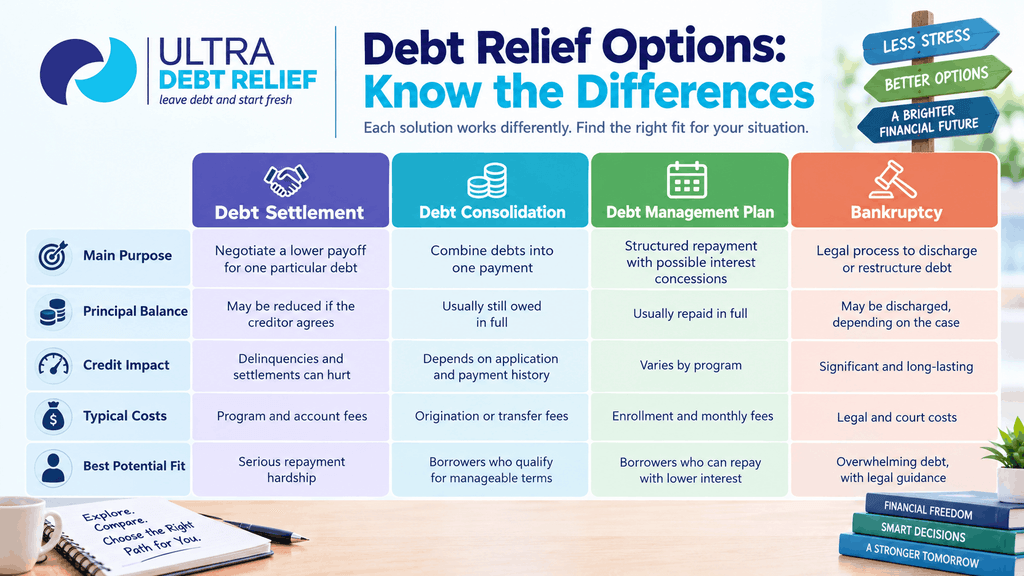
| Feature | Debt settlement | Debt consolidation | Debt management plan | Bankruptcy |
|---|---|---|---|---|
| Main purpose | Negotiate a lower payoff for one particular debt | Combine debts into one payment | Structured repayment with possible interest concessions | Legal process to discharge or restructure debt |
| Principal balance | May be reduced if the creditor agrees | Usually still owed in full | Usually repaid in full | May be discharged, depending on the case |
| Credit impact | Delinquencies and settlements can hurt | Depends on application and payment history | Varies by program | Significant and long-lasting |
| Typical costs | Program and account fees | Origination or transfer fees | Enrollment and monthly fees | Legal and court costs |
| Best potential fit | Serious repayment hardship | Borrowers who qualify for manageable terms | Borrowers who can repay with lower interest | Overwhelming debt, with legal guidance |
Neither choice is automatically superior. If you believe you would be eligible for a lower rate and can handle the payments, consolidation might be a good fit. If you simply aren’t able to make some unsecured debt payments in full, settlement might be an option.
A debt management plan is typically set up with the help of a credit counseling agency. A credit counselor may consolidate payments and seek a reduction in interest, but you’re typically paying down the principal. You can also reach out to your creditors directly for a hardship plan, fee waivers, or settlement, and a nonprofit credit counselor can help you evaluate the options.
Is Debt Settlement Worth It?
It is contingent upon your capacity to make repayments, the nature of the indebtedness, your creditors, and any alternative options.
| Debt settlement may be worth exploring if… | It may be less suitable if… |
|---|---|
| You are facing substantial financial hardship | You can afford your current payments |
| Your unsecured debts are eligible, and you do not have the ability to make full repayments | A low-cost consolidation option is available |
| You understand creditors may refuse to settle | You cannot save enough money to pay settlements |
| You have the money for the funding needs and fees | The majority of your debt is secured or government-related |
| You have compared it with other options | You are involved in a lawsuit and have not received legal advice |
If you’re thinking about bankruptcy, are being sued, or have secured or government-backed debt, check out your options now. If you have significant medical debt, also look into medical debt settlement as a potential alternative. The key is to compare realistic outcomes rather than advertised “savings.”
How to Assess Debt Settlement Agencies
Financial stress can make you vulnerable, so be cautious about who you trust. Use this checklist before you sign.
| Check | What to ask or clarify |
|---|---|
| Fees | A straightforward, written explanation of costs, conditions, and payment scheduling |
| Timeline | How long before offers are made to creditors |
| Risks | Damaged credit, interest, late fees, collections, lawsuits, and taxes |
| Cancellation | What happens if you leave the program or a creditor refuses to settle? |
| Guarantees | Watch out for a guarantee that creditors will accept or that you will end up with a specific amount |
| The agreement | Who delivers the service and which responsibilities are yours |
| The provider | Complaints, credentials where applicable, and legal requirements |
Tip: Beware of debt relief firms that make guarantees or collect fees before providing the service. The Federal Trade Commission cautions consumers about both; see its guide to getting out of debt.
Alternatives to Debt Settlement
Debt consolidation. A consolidation loan can lump multiple accounts into a single one. If it’s a lower rate and you don’t add to your debts, you can take advantage of a lower monthly payment. Compare the APR, fees, and loan term.
Debt management plans. A credit counseling agency can put together a manageable repayment plan and, if possible, ask creditors for interest-rate reductions. Inquire about enrollment fees, monthly fees, which accounts are covered, and the length of time it will take to complete the plan.
Negotiate with your creditor. Tell the creditor about your financial problem and ask to pay less, have fees eliminated, or settle. Make sure you get everything in writing before you pay a lower amount.
Budget-based repayment. If you are able to pay the balances, the debt avalanche approach (highest interest rate first) or debt snowball method (smallest balance first) might help you get more money toward paying off debt.
Bankruptcy. Bankruptcy can be a useful way to resolve crushing debt for some people, but it has big legal and financial drawbacks. Consulting a lawyer can help you determine whether bankruptcy is the right course of action.
How Ultra Debt Relief Can Help
Deciding between debt settlement, consolidation, and other alternatives may seem like an intimidating decision when your balances and interest are difficult to keep up with and your bills can’t be paid on a monthly basis.
Ultra Debt Relief is a matching service that connects consumers with third-party companies that may provide debt-related services. Ultra Debt Relief is not a debt relief company, lender, or direct provider of settlement services. Eligibility, offers, rates, fees, and terms are determined by the third-party provider.
Here is how to use it to explore your options:
- Begin the evaluation. Provide the financial information asked for so that options can be explored. Make sure to be as accurate as possible and go over the site’s privacy guidelines before providing a credit card or other personal or financial details.
- Consider the possibilities. You could be introduced to third parties who might provide services such as debt settlement and debt consolidation, based on your situation and the provider’s offerings. Request information from each about the qualifying criteria, costs, and timing of the service and the impact on your credit and finances.
- Compare offers before you decide. Do not take an offer just because it promises the lowest payments or the highest savings. Compare the total cost, the required contribution, the length of the program, and the risks you are taking with others. It is your call.
- Take the next step. When you are ready, proceed to the online application and check the data asked for and the conditions offered before you submit anything.
Want to explore your options? Request a free, no-obligation consultation and learn what a debt relief plan personalized to your situation might include.
The consultation gives you the opportunity to explore your options. It is not a commitment to approve the case, a specific settlement, or a savings amount.
frequently asked questions
What are the advantages and disadvantages of debt settlement?
Advantages include resolving qualifying debts for less than the full amount and establishing a prospect for recovery. Disadvantages include credit score damage, compounded interest and fees, collection calls, litigation, and tax implications.
Is debt settlement worth it?
You might want to think about it if you are unable to pay back certain unsecured debts in full and you are aware of the risks. Make an informed choice by comparing it to consolidation, debt management, direct negotiation, among others.
What is the impact of debt settlement on my credit score?
Missed payments, delinquent accounts, and accounts listed as settled for less can negatively impact your credit history, but the severity varies based on your credit profile and the way the account is reported.
Can debt settlement reduce credit card debt?
Yes, a creditor can settle for less than the balance on an eligible credit card account. However, creditors are not obligated to settle, and it’s not guaranteed. Depending on the situation, the amount saved can be offset by interest, fees, and other charges.
Are there any settlement company fees?
Fees differ among companies and plans. Request a written fee schedule and ask when fees will be due. Federal regulations prohibit prepayment in certain telemarketed debt relief services, so be wary of a company that wants a prepayment.
Will creditors stop calling me if I sign up?
Not always. You could get bill collectors calling even while a settlement is being negotiated. You may still face collection efforts and a lawsuit if you enroll.
Is forgiven debt taxable?
Some forgiven debt might be taxable income, but there are exceptions and exclusions, including insolvency. If you aren’t sure how a settlement might impact your return, consult a tax expert.
What is the difference between debt settlement and debt consolidation?
Settlement means a lower payoff on one particular debt. Consolidation involves merging various debts into a single new loan or payment plan, and the debt is typically not lowered. There are variations in eligibility, cost, and risk.
Can I negotiate debt settlement myself?
Yes. Ask your creditor or collector if they will accept a settlement or hardship plan. If they do, make sure you get it in writing, that it resolves the debt you want to settle, and keep proof of any payments.
How long does debt settlement take?
There’s no magic number. The length will depend on how many debts there are, how much money you have, how your creditors respond, and how the program is structured. Ask a provider for a ballpark figure and keep in mind that settlements can’t be guaranteed.
Final Thoughts
Knowing the advantages and disadvantages of debt settlement is an important part of making an informed decision. While settlement may be one option for some to settle a qualifying unsecured debt for less than the full amount owed, it also means credit damage, additional costs, collection calls, and potentially, taxes.
Before you sign up, look over your budget, ask questions regarding fees and qualifications, and weigh settlement against consolidation, credit counseling, direct negotiation, and other alternatives. Never deal with a company that guarantees results or makes “hard-to-believe” claims.
Ultra Debt Relief can refer you to third-party companies that provide services for your debt. Look into what each company’s terms are, and select only what you can afford.
Disclaimer: This publication should not be considered financial, legal, or tax advice and is for educational purposes only. UltraDebtRelief.com is a referral service and is not a debt relief company or lender. Third-party providers select qualifying criteria, range of debt, acceptable debts, services provided, fees, and rules. You may not see debt reduction, credit enhancement, or collection activity or litigation protection through debt settlement.
Suggested
- How to Get Out of Debt When You Can’t Afford Your Payments
- How Debt Relief Works: Understanding Your Options
- Top Companies for Credit Card Debt Forgiveness
- Debt Consolidation vs. Personal Loan: Which Option Is Right for You?
- Credit Card Debt Relief for Nurses: Programs, Options & Financial Solutions in 2026