
Healthcare professionals dedicate their life to helping other people, but many nurses are faced with financial difficulties in their personal lives. Between student loans or credit card balances growing living costs as well as family obligations, and unexpected costs credit card debt could quickly become overwhelming.
If you’re a nursing professional struggling with Credit Card Debt Relief for Nurses that is high-interest it’s not an isolated issue. The good news is that a number of credit card debt relief options are readily available to ease debt burden, ease repayment and help you get back on track to financial stability.
In this article we’ll discuss the most effective debt relief options for credit cards for nurses, how they operate and how you can determine the right option for you.
Why Nurses Often Struggle with Credit Card Debt
Common reasons why nurses accumulate credit card debt are:
- Student obligation to repay loans
- Medical and family costs
- Transportation and housing costs
- Childcare expenses
- Emergencies
- Work hours reduced or job changes
- High-interest credit card use
Many nurses depend on credit cards to fill short-term financial gaps, however the high rates of interest can make it difficult to pay back in the long run.
What Is Credit Card Debt Relief?
Debt relief from credit cards is a term used to describe strategies and programs created to assist consumers in managing their debt, pay down or reduce their credit card debts more efficiently.
The aim is to:
- Lower monthly installments
- Reduce the interest costs
- Simpler repayment
- Do not make the collection
- Improve financial health
Based on your financial situation the process of debt relief can include debt settlement, condensing, debt control programs and credit counseling.
Signs You May Need Credit Card Debt Relief
You could be able to benefit from a debt relief program in the following situations:
- Only make the minimum monthly payment.
- The credit card balances keep to grow.
- Collection agencies are reaching out to you.
- Credit cards are used to pay for another.
- It is difficult to pay for important living expenses.
- The cost of interest makes it difficult to reduce the balances.
- In the long run, financial stress is caused by debt.
Early action can help to prevent debt from becoming complicated to handle.
Nursing is among the most prestigious and vital jobs in the field of healthcare However, it has unique financial issues that make managing debt a challenge.Debt forgiveness for nurses often work long shifts, rotate schedules, night shifts and physical demanding jobs that can result in fatigue or financial pressure. Although nursing can provide steady employment, many healthcare professionals are still faced with significant costs such as student loan repayments as well as housing, childcare costs, transportation and healthcare-related costs for their families.
In addition, travel nurses, recently licensed nurses and single-parent nurses as well as those who reside in areas with high costs could face additional financial strain. Emergencies that are not expected, such as car repairs, medical bills or short-term reductions in working hours could force nurses to use credit cards to cover their daily costs. In time the high-interest balances on credit cards could build up, making payment more challenging and adding to overall burden on the financial system. In the end, a lot of nurses are seeking debt relief strategies to help them regain control over their finances and achieve longer-term financial stability.
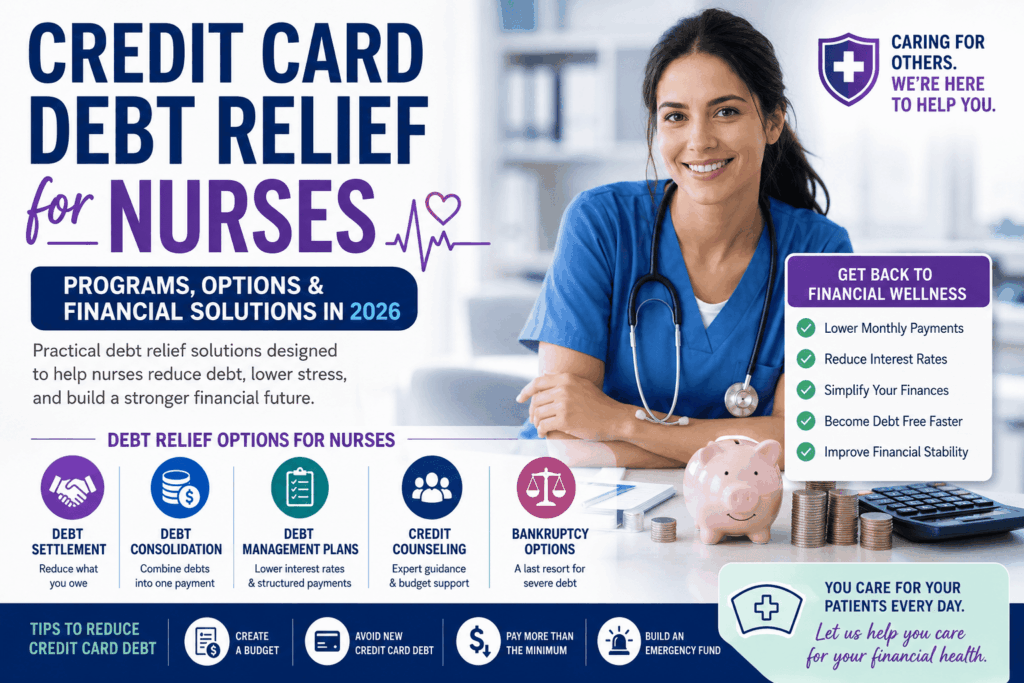
Best Credit Card Debt Relief Options for Nurses
1. Debt Settlement
Debt settlement is the process of negotiations with creditors to reduce the amount due.
A debt settlement firm cooperates with creditors in order to agree to accept less that the entire amount as a payment.
Pros
- Potential debt reduction
- Payoff time is faster
- Alternatives to bankruptcy
Cons
- Credit score can be affected
- Not all lenders participate
- Program fees can be charged
The concept of debt settlement is frequently regarded by nurses who have a large amount of unsecure credit card debt.
2. Debt Consolidation
Debt consolidation for nurses consolidates multiple credit card balances into one payment.
This could be done by:
- Personal credit
- Credit cards that allow balance transfer
- Products for home equity (where appropriate)
Benefits
- One monthly installment
- Easier budgeting
- Potentially lower rates of interest
Drawbacks
- Requirements for qualification
- May not reduce total debt owed
Debt consolidation is a good option for nurses who have stable income and decent credit scores.
3. Debt Management Plans (DMPs)
A debt management program is usually managed by a credit counseling agency that is a non-profit.
The agency negotiates interest rates at a lower rate and combines payments into one monthly sum.
Benefits
- Interest rates are reduced
- Plan of repayment structured
- Professional Support
Considerations
- Requires consistent payments
- The program’s completion could require several years to complete.
4. Credit Counseling
Counseling services for nurses can help them learn about their finances and devise practical strategies for repayment.
Services usually comprise:
- Budget analysis
- Review of debt
- Financial education
- Recommendations on managing debt
Many non-profit organizations provide low-cost counseling services.
5. Bankruptcy
Bankruptcy is generally considered a last-resort option when debt becomes unmanageable.
Chapter 7 Bankruptcy
May discharge qualifying unsecured debts.
Chapter 13 Bankruptcy
Creates a structured repayment plan.
Because bankruptcy has long-term financial implications, nurses should consult a qualified attorney before pursuing this option.
How Nurses Can Reduce Credit Card Debt Faster
Create a Monthly Budget
Keep track of your expenses and income to determine possibilities for repayment of debt.
Prioritize High-Interest Debt
Make sure you focus on balances with most interest rates first.
Avoid New Credit Card Debt
The reduction in spending will stop deficits from rising further.
Build an Emergency Fund
A small emergency fund can cut down of credit card.
Consider Additional Income Opportunities
Many nurses earn extra money through:
- Overtime shifts
- Per diem nursing
- Travel nursing assignments
- Telehealth opportunities
Debt Relief vs. Debt Consolidation
| Feature | Debt Relief | Debt Consolidation |
|---|---|---|
| Purpose | Reduce debt burden | Simplify repayment |
| Monthly Payments | Often lower | Combined into one payment |
| Credit Impact | May be higher | Usually lower |
| Debt Reduction | Possible | Generally no |
| Timeline | 2–4 years | 3–7 years |
Benefits of Debt Relief for Nurses
Reduced Financial Stress
The task of managing healthcare obligations is hard enough without a huge amount of debt.
Improved Cash Flow
A lower payment could allow money to cover important expenses.
Better Financial Planning
Structured repayment plans provide clear goals.
Faster Debt Elimination
Numerous programs assist consumers in becoming debt-free earlier rather than making the minimum payment indefinitely.
Credit Card Debt Among Healthcare Workers
Healthcare professionals play a critical role in caring for patients and supporting communities, yet many face financial challenges of their own. Despite working in a stable and essential industry, nurses and other healthcare workers often balance multiple financial obligations, including student loans, housing expenses, transportation costs, childcare, healthcare expenses, and everyday living costs. These financial responsibilities can place significant pressure on monthly budgets, especially for those early in their careers or supporting families.
In recent years, rising inflation and increasing living expenses have made it more difficult for many healthcare workers to manage their finances effectively. As a result, some nurses rely on credit cards to cover emergency expenses, unexpected medical costs, home repairs, or temporary income gaps. While credit cards can provide short-term financial flexibility, high interest rates can cause balances to grow quickly when only minimum payments are made.
| Option | Best For | Credit Impact | Monthly Payment |
|---|---|---|---|
| Debt Settlement | High debt balances | Moderate-High | Lower |
| Debt Consolidation | Good credit borrowers | Low-Moderate | Fixed |
| Debt Management Plan | Consistent income | Moderate | Structured |
| Credit Counseling | Budget assistance | Minimal | N/A |
| Bankruptcy | Severe hardship | High | Varies |
Expert Advice
As an expert for debt relief, you know that debt is a big burden for anybody. Today, we are talking about nurses, who are frontline workers and often require loans for their homes and other activities. But the burden of paying high interest rates increases the pressure on their pockets.
You know that an 18% interest rate is too costly for anybody. One of my friends who works as a nurse in a hospital near Tennessee told me about the financial burden she was facing. She is a real-life example of someone whose life changed after I shared the advice. She was carrying $22,000 in credit card debt across four accounts, with interest rates ranging from 18% to 29%. Making minimum payments each month resulted in slow progress and significant interest costs.
The burden of debt was causing stress in her daily life, and she couldn’t work freely without constantly worrying about her finances. After discussing her situation, I helped her understand her options, and she eventually enrolled in a debt management program that consolidated her payments and reduced interest rates. Results can vary depending on each person’s financial situation and level of debt. Still, in her case, it helped her recover from a difficult financial situation and regain control of her finances.
Final Thoughts
Nurse Credit card debt relief can create significant financial stress for nurses, but several debt relief options are available. Whether you’re considering debt settlement, debt consolidation, credit counseling, or a debt management plan, understanding your options is the first step toward regaining financial control.
With the right strategy and professional guidance, nurses can reduce debt, improve financial health, and focus on what matters most: caring for their patients and building a secure financial future.
Author Note: This article is for informational purposes only and should not be considered legal, tax, or financial advice. Consumers should consult qualified financial professionals before making debt-related decisions.
Can nurses qualify for debt relief programs?
Yes. Nurses may be eligible for various solutions to reduce debt, including debt settlement and credit counseling, debt consolidation and debt management programs. In order to qualify, you must meet certain criteria like the amount of debt as well as income and financial situation.
Is debt settlement a good option for nurses?
Debt settlement could be beneficial for nurses who have substantial debts that are not secured by a loan and who are in financial difficulty and finding it difficult to make the monthly payment. It is crucial to consider the potential advantages and the potential dangers prior to enrolling.
How do I apply for credit card debt relief for nurses?
The process for applying typically begins with a complimentary consultation or a financial assessment. A debt expert analyzes your debt, income and goals in financial terms to figure out if the debt negotiation, consolidation or other relief options might be the best option for you.
Can nurses get credit card debt relief?
Yes. Nurses can avail the same solutions for debt relief that are available to all customers, such as debt settlement as well as debt consolidation and management plans, as well as debt counseling services. The best choice is dependent on the individual’s financial situation.
Is nurse credit card debt relief legitimate?
Legal debt relief programs exist, but it’s essential to study the providers thoroughly. Be sure to look for transparent pricing, positive reviews from customers with clear information, and solid industry experience prior to signing up for any program.
Can nurses get credit card debt forgiven?
In certain situations there are debt settlement programs that can aid in reducing the amount due on debts that are not unsecured for example, the balance of credit cards. However, total debt forgiveness is not common and is contingent on the policies of creditor and the individual situation.
Are there hardship loans for healthcare workers with bad credit?
Some financial institutions and lenders programs offer hardship loans and financing options for healthcare professionals with credit scores that aren’t perfect. The requirements for qualification as well as interest rates and repayment terms are different for each lender, therefore comparing several alternatives is advised.
What is the best debt relief option for nurses?
The ideal solution will depend on the amount of debt as well as income, credit score and your financial plans. Debt consolidation could be a good option for nurses who earn a steady income and credit score however debt resolution or debt management plans could be more appropriate for those who are struggling financially.
How long does a debt relief program take to complete?
The majority of debt relief programs last anywhere from 24-to-60 months to finish depending on debt size, the repayment capacity, and the type of program you choose.
Can nurses with multiple credit cards qualify for debt consolidation?
Yes. There are many debt consolidation programs specifically designed to assist consumers consolidate multiple credit card balances into one monthly payment and make the debt less burdensome to manage.
Will debt relief stop collection calls?
The program’s effectiveness will depend on the involvement of creditors Debt relief can help decrease collection activity over time. However, results differ based on the creditor and personal circumstances.
Can travel nurses qualify for debt relief programs?
Yes. Travel nurses may be eligible for debt relief programs provided they meet the eligibility criteria. The nature of their work does not hinder them from obtaining the debt relief, consolidation or credit counseling services.