

Overview
If you’ve fallen into credit card debt, it can be difficult to get back on track. High interest rates and minimum payments on your credit cards may only cover a small portion of the actual debt. If you miss a payment, what was once a manageable situation can quickly become stressful. For consumers facing these challenges, debt settlement for credit card debt may be one option to consider when exploring ways to manage outstanding balances.
You may have also come across debt settlement as a potential solution. This guide explains how credit card debt can be settled, how settlement may affect your accounts and credit score, what costs may be involved, and how to decide whether it is the right choice for your financial situation. This guide is intended for consumers in United States.
Can credit card debts be settled?
Yes, in many cases credit card debts can be settled by coming to an agreement with your card provider or debt collector. However, this generally involves paying a lump sum, may negatively affect your credit rating, may cause you to owe tax and is not guaranteed as acceptance of the offer is at the discretion of the creditor.
Key points
- Credit card debts can be settled with a reduced payment in most cases. As credit cards are unsecured debts creditors may be open to settling.
- Settling debts may negatively affect your credit rating. Any debt forgiven may be liable for tax. While you can attempt to settle debts by yourself, or with a firm, there is no guarantee of success. Consider alternative debt solutions to settle your debt.
Inside this guide
- What is credit card debt settlement?
- Special circumstances
- What happens if you stop making payments?
- How can you settle credit card debt?
- How much can you settle?
- Pros and cons, impact on credit and tax
- Costs
- Settling credit card debt by yourself
- Your rights with debt collectors
- With a firm
- Alternative options
- FAQ
What is credit card debt settlement?
Credit card debt settlement involves getting to an agreement with your creditor to pay less than the full balance. For example, if you owe $10,000 on your credit card, you might be able to come to an agreement with the provider to pay a reduced amount instead. Once you’ve paid, you will be out of debt with that account. The exact amount you pay in settlement depends on the creditor, how far in arrears you are and how much you can afford to pay.
Differences from other methods
Credit cards are unsecured debts. This means there is nothing to secure the debt, unlike secured debts (such as mortgages). If you fall into arrears with your mortgage, the lender can repossess. However, if you fall into arrears with credit card debt, the card issuer cannot take anything from you directly. They can attempt to collect, sell your debt or take legal action.
Due to this, settlements are often possible. As credit cards are an unsecured debt, if a creditor is unable to collect the entire debt, they may be more inclined to settle for a reduced amount to get some of the money back quickly. Similarly, other unsecured debts (like medical bills and personal loans) can often be settled in the same way.
What happens if you stop making payments?
Below we’ve given you an overview of what generally happens if you stop making payments on your credit card, so you can understand why creditors may be more willing to settle the debt as time goes by.
| Number of days in arrears | What may happen |
| 30 days | Payment may be marked as late. Late charges may occur. |
| 60-90 days | More calls and letters. Interest rate may increase. Account may be closed. |
| 120-180 days | Card provider may prepare to write the debt off. |
| ~ 180 days | Account is typically written off. You are still in debt. |
| After being written off | The debt may be retained by the card provider, passed to internal debt collection, or passed on to a debt collector. |
A debt written off does not mean that you are not liable for it. It is an accounting measure for the card provider. It will be marked as a negative entry on your credit report. The debt can be collected and settled.
How to settle credit card debt
Whether you settle credit card debt by yourself or using a firm, the process is very similar.
List debts
List all card debts. Note what the balance, interest rate and status of the debt is (current, in arrears or with a debt collector).
Decide how much money you can pay.
Save
Many people save regularly into a separate account. When enough money has been saved, offers can be made.
Make an offer
Make an offer to either the creditor or debt collector. The amount offered should be below what you are willing to pay. The creditor may agree, make a counter offer or refuse.
Get agreement in writing
Before sending money, ensure that there is an agreement in writing that the payment covers the debt fully.
Make payment and keep records
Ensure that the payment is traceable. Keep the letter and proof of payment.
Note that while saving up to settle debts, you may be in arrears with the accounts. This can mean you will be charged further late fees, incur more interest, receive calls from debt collectors and potentially face legal action. As with any debt settlement, there is a trade off to be considered.
How much can you settle credit card debt for?
There is no set amount. The amount of money you can settle credit card debt for will vary greatly. If a firm is offering to settle your debt for a specific percentage, they are promising too much. The amount you may be able to settle your debt for depends on:
- How far in arrears you are. If you are a long time in arrears, creditors may be more likely to be flexible.
- Who the debt is with. If the debt is with a debt collector, and the debt was purchased at a large discount, the debt may be settled for less than with the original company.
- Your situation. If you can provide evidence of difficult financial circumstances (such as losing a job or incurring medical costs), this may help.
- Amount of money in offer. Offering a lump sum is generally more appealing.
- Policies of the creditor. Some card providers are likely to settle debts easily, while others rarely do.
Do not take figures given in online examples as set figures. How much you can settle your debt for will depend on your creditors.
Pros and cons of settling credit card debt
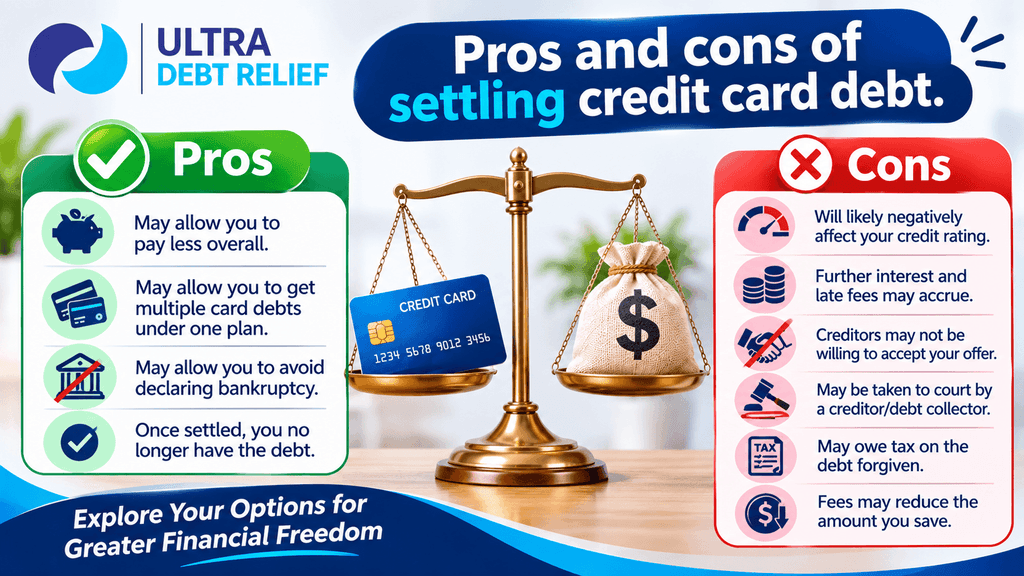
| Pros | Cons |
|---|---|
| May allow you to pay less overall. | Will likely negatively affect your credit rating. |
| May allow you to combine multiple credit card debts under one structured repayment plan. | Further interest and late fees may accrue. |
| May help you avoid declaring bankruptcy. | Creditors may not accept your settlement offer. |
| Once settled, you no longer owe the settled debt or accrue further interest and minimum payments on it. | A creditor or debt collector may take legal action against you. |
Impact on credit rating
Debt settlement is likely to negatively affect your credit rating. Missed payments will be recorded on your credit report, and settled debts are often indicated as ‘settled’ or “settled for less than the full balance.” This means future lenders can see that you have not paid the full amount.
However, this effect is not permanent. Negative entries on credit reports will generally be removed after up to 7 years from the point you made your first late payment. Over time, their impact becomes less significant. Many people begin to rebuild their credit rating while this negative entry is still on their credit report, by making all their payments on time, keeping balances low and ensuring there are no errors on their reports. If you are planning on taking out a mortgage or car loan soon, consider the timing of settling debts.
Tax implications of settling credit card debts.
Yes, in many cases. As cancelled debts are generally considered income by HMRC, if you are forgiven $600 or more by a creditor, you will likely be sent a 1099-C form. You may need to declare the forgiven amount on your tax return. If you had $10,000 in debt and settled it for less, the difference in amount may be declared as taxable income.
There are exceptions. If you were insolvent, meaning that just before the debt was cancelled, your total debts were greater than the value of your assets, then you may not be liable. As tax is personal, consider speaking to a tax professional to plan for any payment you may have to make.
Costs of debt settlement
If you settle debt with a company, be sure to ask exactly how you will be charged. In accordance with federal guidelines, debt settlement services provided over the telephone generally cannot charge you any fees until at least one of your debts have been settled, and you have made a payment towards the settling. It is common to be charged a percentage of the debt you have enrolled in or the amount you have saved.
Ask to see a written breakdown of all the fees, at what point in the process you’ll be charged and what happens if you leave the programme early. Be sure to consider all costs involved in settling your debt (interest/late fees accrued, and potential tax implications) in comparison to how much money you expect to save.
Settle credit card debt by yourself.
While it is possible to attempt to settle debt by yourself, it can be difficult. Below are tips to help you:
- Know who you owe. Request confirmation of the name of the creditor, the account number and the current balance of the debt, in writing.
- Know how much you can pay. Decide on the maximum amount you can pay, and make an initial offer below this.
- State your difficulty. Briefly explain what has caused you difficulty.
- Offer a lump sum. Usually creditors respond better to a lump sum.
- Ensure it is in writing. Ensure the letter states that with this payment, the debt is fully settled. It should also state that the balance will be marked as $0 or settled.
- Ensure safety with your bank account. Do not allow people access to your account. Make the payment in a way that you have control over.
- Be aware of time lines. In certain states, making certain payments or acknowledging debts in writing which are very old may reset the time limit for legal action. Be sure to check the rules in your state.
While saving to settle debt by yourself saves you money on fees, it can be time consuming and require determination, particularly if you have multiple credit card debts.
Your rights with debt collectors
Regardless of whether you settle by yourself or with a company, you do have protections under federal law. Under the Fair Debt Collection Practices Act, debt collectors must send you a letter containing information about the debt. In general, you should have 30 days from receiving the letter to contest the debt or request verification. Collectors may not be harassing, abusive or threatening.
If you would like to stop a debt collector contacting you, you can send them a letter to this effect. While this does not remove the debt, it may stop debt collectors contacting you. Be sure to keep copies of any letters you send. To get proof of delivery on important letters, send them via certified mail. If a debt collector is acting outside of their guidelines, you can make a complaint to the Consumer Financial Protection Bureau or your state attorney general.
What to consider with debt settlement firms.
If you’d prefer to get help with debt settlement, be very careful to compare. A reputable firm should clearly be able to answer:
- All of the fees and when you will be charged them.
- How long the programme is likely to take.
- What will happen to the accounts while you save up.
- Risks to expect (including impacts on credit ratings and potential legal action).
- What happens to your savings if you cancel.
Be wary of anyone promising results, asking for large deposits, telling you to ignore debt collectors (without explaining potential risks) or pressuring you to sign up quickly.
Alternative options.
Consider the following options.
| Option | How it works | Best if… |
| Debt consolidation loan | All credit cards are paid off with one loan. The loan is paid in full. | You can make payments and qualify for a better rate. |
| Balance transfer | Balances are transferred onto a card with a very low introductory rate. | You can pay the balance off before the introductory period ends. |
| Debt Management Plan | A not for profit credit counselling service negotiates lower rates and combines payments. | You want to pay the debt in full, but need a lower interest rate. |
| Debt settlement | Negotiate paying less than the full amount. | You are in arrears, or realistically cannot pay the full amount. |
| Bankruptcy | Legal process overseen in court. | You have a very large debt in comparison to your income. |
Generally, debt consolidation or credit counselling will have less of a negative impact on your credit rating than debt settlement or bankruptcy. If you cannot keep up with payments, it may be worth considering debt settlement or bankruptcy (ideally with guidance from a qualified professional).
Should you settle debt?
It often makes most sense to settle debts if most of your debt is unsecured, you are in (or about to be in) arrears, most of your minimum payments are covering interest and realistically you cannot pay the full amount within a few years. It may make less sense to settle if you are up to date with payments, have a small amount of debt, or if you need a good credit rating soon. To decide, add up how much debt you have, what income and outgoings you have and compare between at least 2 or 3 options.
How we can help
UltraDebtRelief is a matching service. We do not provide debt relief or loans. We match people to third party companies who may be able to provide debt related services, such as credit card debt settlement. By completing a quick free assessment, a partner company will assess your situation and explain which options may be best for you. We do not make decisions on credit, nor can we guarantee approval, rates, outcomes or timeframes.
Be sure to read through any terms of the service, fees, eligibility criteria and potential impacts of the programme with any companies you are matched with. If you would like to discuss further, please call (888) 771-0344 or visit UltraDebtRelief.com.
Useful resources
Below are official sources for general information on debt, debt collection, and taxes.
- Consumer Financial Protection Bureau – Advice on debt collection, credit reports and consumer rights
- Federal Trade Commission – Tips for handling debt and avoiding debt relief scams.
- Internal Revenue Service – Information on cancelled debt and form 1099-C.
Final thoughts
Considerations
Settling debt will reduce the total amount of money you have to repay, however, settling debt may affect your credit rating, may incur tax on the amount of debt forgiven, and there is no obligation for creditors to agree. This solution is generally more suitable for those who are struggling with their debts.
Considerations
Ensure that you know how much you owe, and consider what option is best for you from consolidating debt, transferring balances, creating a debt management plan, or declaring bankruptcy. Ensure that all costs are clear, and any agreements made are in writing. If negotiating debt settlement alone or with a company, allow enough time to do so, and ensure that no one makes guaranteed promises.
Getting assistance
UltraDebtRelief.com can connect you with third parties to help you. We cannot offer debt relief or lending. We cannot guarantee approval for, or rates, results or timelines from any services. Please review the terms and conditions, costs and requirements of each company to see if they are right for you. For more information, please call (888) 771-0344.
Frequently Asked Questions
What is credit card debt settlement?
Paying off a debt for less than the total amount owed to close an account. This is usually paid in one lump sum.
Can I negotiate credit card debt?
Yes. Contact the company/collector and submit an offer. It is important to get the terms in writing, and keep records.
How much can I pay for my credit card debt?
This depends on several factors including the company, how overdue the debt is, the owner of the debt and how much you can pay. Nobody can guarantee how much they would be able to reduce your debt for.
Will settlement affect my credit score?
Most of the time. Not making payments and having a ‘Settled’ status may lower your credit score. Negative items on your credit report can remain there for up to 7 years. However, this will usually improve over time.
Is credit card debt settlement taxable?
This can very often be. Any forgiven debt may be considered income. If $600+ of debt is forgiven, the company will likely issue you with a 1099-C form. There may be exceptions to this, such as if you’re insolvent. Speak to a tax professional.
How long does credit card debt settlement take?
Many debt settlement plans will take between 2-4 years depending on how much debt you have, how much you can save per month and how the company deals with you. If however you are negotiating directly with a company in relation to one debt, it may be quicker.
Can a credit card company take me to court for debt?
Yes. If you have fallen behind on payments, your company or collection agency may be able to take you to court. If you receive any documents from court, be sure to reply within the given time frame. You may also want to speak to a solicitor.
Is debt settlement the same as debt consolidation?
No. Debt consolidation means you combine all of your debts into one loan and pay this back in full. Debt settlement means you attempt to reduce the overall amount you owe.
Which debts can I settle?
Alongside credit card debt, you can often settle unsecured debts, such as medical bills, personal loans and some collections. Debts secured against an asset (such as mortgage or car loans) are generally not a good candidate for settlement.
What rights do I have as a debtor?
If contacted by debt collectors, under the Fair Debt Collection Practice Act, they should provide you with written details. You have 30 days to contest the debt. They cannot harass you. You can also request they stop contacting you via written communication.
Notice
UltraDebtRelief.com is not an organization for debt relief or a lender. We are not a financial institution. Our service is a non-profit matchmaking service that connects consumers to third-party companies that may provide debt-related services. We are not able to make credit or lending decisions, or guarantee approval, or offer legal, financial, and tax-related advice. USAA is a trademark registered by its owner and is used for informational purposes only. There is no affiliation, endorsement, or sponsorship implied.
.
Recommended
- Debt Negotiation vs. Debt Consolidation: Key Differences, Pros & Cons
- Best Debt Settlement Affiliate Programs in 2026
- How to Get a Debt Consolidation Loan in 5 Steps
- Can You Use a Credit Card for a Car Down Payment?
- Debt Settlement Pros and Cons: Benefits & Risks
Tags: Debt Settlement, Debt Relief, Debt Consolidation, Ultra Debt Relief