
If you’re looking at a pile of credit card bills, medical bills, and maybe an old department store card you haven’t used in ages, don’t worry. Millions of Americans are in the same situation, with multiple accounts, each with its own due date, interest rate, and minimum payment, all while trying to remember to make every payment on time.
A debt consolidation loan can be a practical way to clean up that mess. You take out a single new loan, use the funds to pay off your existing debts, and then make one monthly payment. If the math works in your favor, you can lower your interest costs, simplify your bills, and give your debt a clear end date.
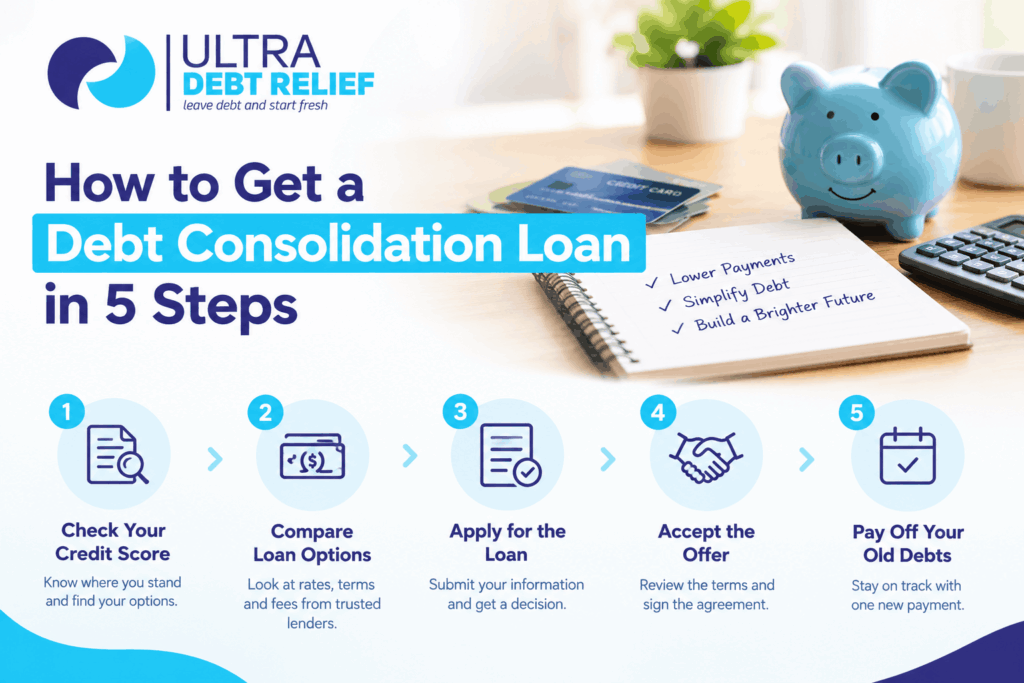
Quick answer: To get a debt consolidation loan, follow these 5 steps:
Step 1: Check your credit and list your debts
Step 2: Decide how much to borrow
Step 3: Compare lenders and prequalify
Step 4: Apply with your documents
Step 5: Use the funds to pay off your old accounts and stick to a repayment plan
Most lenders look at your credit score, income, and debt-to-income ratio.Key takeaways
- A debt consolidation loan combines several debts into one loan with one monthly payment.
- It only saves money if the new rate and fees cost less than what you pay now.
- Prequalifying with a soft credit check lets you compare offers without hurting your score.
- Many lenders prefer a debt-to-income ratio under about 40%, though it varies.
- Consolidation doesn’t fix spending habits, so don’t run the cards back up.
- Debt settlement is another option, and it can affect your credit and carry fees.
What is a debt consolidation loan?
A debt consolidation loan is a loan used to pay off other debts, leaving you with one fixed monthly payment instead of several.
Most are unsecured personal loans, which means you don’t put up your home or car as collateral. They typically come with a fixed interest rate, a fixed monthly payment, and a fixed repayment term, often between two and seven years.
Once you’re approved and the loan is funded, the money is used to pay off your old balances. Some lenders send the payments directly to your creditors. Others deposit the funds in your bank account, and you make the payments yourself. After that, you only deal with the new lender.
People commonly use a debt consolidation loan for:
- Credit card balances
- Store cards and retail financing
- Medical bills
- Higher-rate personal loans
- Payday or other short-term loans
You typically wouldn’t want to roll federal student loans into a private consolidation loan. Federal loans come with benefits, such as income-driven repayment plans and some forgiveness options, that you would lose if you moved them into a private loan.
How does debt consolidation work?
Debt consolidation works by replacing several high-interest debts with one new loan, ideally at a lower rate, so more of each payment goes toward the balance.
Numbers make this easier to understand, so let’s walk through a hypothetical example. The balance, monthly payment, and fee below are made up for illustration only. They are not based on a real person or lender, and they are not an offer or a guarantee.
To keep things realistic, the interest rates are based on recent averages from the Federal Reserve’s G.19 Consumer Credit report, which shows average credit card rates of around 22% and average 24-month personal loan rates at commercial banks of around 12%. These are averages. The rate you’re offered could be higher or lower.
Say you have four credit cards totaling $15,000, with an average interest rate of about 22% APR, and you’re paying around $450 a month toward them. It would take roughly 52 months, a little over four years, to pay off those balances, and you’d pay about $23,400 in total. Around $8,400 of that goes to interest alone.
Now say you qualify for a $15,000 debt consolidation loan at 12% APR over 48 months.
| Keep paying the cards | Consolidation loan (no fee) | Consolidation loan (5% fee) | |
| Amount to pay off | $15,000 | $15,000 | about $15,790 borrowed to net $15,000 |
| Interest rate | ~22% APR | 12% APR | 12% APR |
| Monthly payment | ~$450 | ~$395 | ~$416 |
| Time to pay off | ~52 months | 48 months | 48 months |
| Total paid | ~$23,400 | ~$18,960 | ~$19,960 |
| Total interest and fees | ~$8,400 | ~$3,960 | ~$4,960 |
This example is hypothetical. Interest rate averages: Federal Reserve G.19 Consumer Credit release. Actual rates, fees, and payments vary by lender and borrower.
In this example, consolidating saves roughly $3,400 to $4,400 and gets you out of debt a few months sooner, even after an origination fee. Pay attention to the fee, but pay even closer attention to the rate.
Now flip it around. If the best rate you could get was close to what your cards charge, and the fee was high, your savings would shrink to almost nothing, and consolidating wouldn’t be worth it. That’s why comparing offers before you decide makes such a difference.
How do you get a debt consolidation loan?
You get a debt consolidation loan by checking your credit, choosing a loan amount, comparing lenders, applying, and then using the funds to pay off your existing debts.
The 5 steps at a glance:
- Check your credit and list all your debts
- Decide how much you need to borrow
- Compare lenders and prequalify
- Apply and submit your documents
- Pay off your debts and build a repayment plan
Step 1: check your credit and list all your debts
Know where you stand before you apply. Two things matter most here.
Your credit score and reports. Lenders look at your credit to decide whether to approve you and what rate to offer. Most of the best rates go to borrowers in the good-to-excellent range (roughly 670 and above). If your score is lower, you can still qualify with some lenders, but you’ll likely pay a higher rate. You can get your credit reports for free at AnnualCreditReport.com, and many banks and card issuers show your score in their apps.
While you’re reviewing your reports, watch for errors. A balance that isn’t yours, or a payment marked late that you actually made on time, can pull your score down. If you find a mistake, file a dispute with the credit bureau. Fixing it before you apply could help you qualify for a better rate.
Your full list of debts. Make a simple list of everything you want to consolidate, including:
- The name of the lender or card
- The current balance
- The interest rate (APR)
- The minimum monthly payment
Add up the balances and the monthly payments. This is your baseline, the number any new loan has to beat.
Then work out your debt-to-income ratio (DTI), which is your total monthly debt payments divided by your gross monthly income. If you earn $4,500 a month before taxes and $1,500 goes toward debt, your DTI is about 33%. Many lenders prefer a DTI under roughly 40%, but the cutoff varies.
Step 2: decide how much you need to borrow
Start with the total of the balances you plan to pay off, then think through a few more things.
Fees. Many lenders charge an origination fee, which is a percentage of the loan amount that’s subtracted from your funds. That means you may need to borrow more than $15,000 to actually receive $15,000. Always ask what you’ll net.
A payment you can really afford. Take an honest look at your monthly budget. A lower payment is tempting, but it usually comes with a longer term, and a longer term means more interest. Aim for a payment that fits your budget and a term short enough to keep your total cost down.
Your loan term. Here’s a quick summary:
| Loan term | Monthly payment | Total interest |
| Shorter (2 to 3 years) | Higher | Lower |
| Longer (5 to 7 years) | Lower | Higher |
It’s also tempting to borrow a little extra “just in case.” Try not to. The goal is to get out of debt, and borrowing more works against that.
Step 3: compare lenders and prequalify
Getting quotes from at least three lenders before you apply is the best way to save money on a debt consolidation loan, and it’s the step most people skip. You can find these loans from several types of lenders:
- Banks. A decent place to start if you already have an account, since some offer rate discounts to existing customers or for setting up autopay.
- Credit unions. They often have lower rates and more flexible approval standards, especially if your credit is fair. You usually need to be a member, but joining is often easy.
- Online lenders. Simple applications, fast decisions, and a wide range of credit profiles considered. Funding can be quick, sometimes within days.
When you compare offers, look beyond the headline interest rate.
| What to compare | Why it matters |
| APR | Includes interest and certain fees, so it’s the best way to compare loans side by side |
| Origination fee | Reduces the money you actually receive |
| Loan term | Changes your monthly payment and your total interest |
| Prepayment penalty | You should be able to pay off the loan early without extra charges |
| Direct payment to creditors | Some lenders pay your old accounts for you, which helps you stay on track |
| Funding speed | Important if you have due dates coming up |
| Hardship options | Some lenders offer help if you hit a rough patch |
What makes comparing easy is prequalification. Most lenders let you check your likely rate and terms with a soft credit inquiry, which does not affect your credit score. Prequalify with three to five lenders, line up the offers side by side, and compare the total cost of each loan, not just the monthly payment.
A heads up: prequalified offers are estimates. The final rate can change after the lender completes its review.
Step 4: apply and submit your documents
Once you’ve chosen the offer you want, you’ll submit a formal application, which usually includes a hard credit inquiry. This can cause a small, temporary dip in your score, which tends to recover as you make on-time payments.
Lenders often ask for:
- A government-issued photo ID
- Proof of income, such as pay stubs, W-2s, tax returns, or bank statements
- Proof of address
- Your Social Security number
- A list of the debts you want to pay off, with account numbers and balances
Having these ready in advance can save a lot of time. Many online lenders decide within minutes to a couple of business days, and funds commonly arrive within about one to seven business days after approval. Banks and credit unions can take a little longer.
Review the loan agreement before you sign. Check that the final APR, fees, monthly payment, due date, total amount to be repaid, and any penalties match what you were told. If they don’t, ask before you accept.
If approval is a challenge, a few things might help:
- Apply with a co-signer or co-borrower who has stronger credit (they become responsible if you miss payments)
- Look at credit unions, which often work with a wider range of credit profiles
- Consider a secured loan, but remember it puts your property at risk if you can’t repay
- Build your credit for a few months first by paying down balances and making every payment on time
Step 5: pay off your debts and build a repayment plan
Approval is only the beginning. What you do after the funds arrive determines whether consolidation really works.
- Pay off the old accounts right away. If the lender doesn’t pay your creditors directly, do it yourself as soon as the money lands, then confirm that each account shows a zero balance.
- Set up autopay. A missed payment on your new loan can cost you fees and hurt your credit. Autopay helps you avoid that, and some lenders offer a small rate discount for using it.
- Don’t let the cards fill back up. This is the most common pitfall. Once the balances are cleared, it’s tempting to start spending again. If that’s a concern, put the cards away, ask for lower limits, or use them only for planned purchases you pay off in full.
- Start a small emergency fund. Even a few hundred dollars can keep a surprise expense from landing on a credit card.
- Pay extra when you can. If your loan has no prepayment penalty, extra payments cut your interest and bring your payoff date closer.
- Keep old accounts open if they have no fees. Closing older accounts can shorten your credit history, and closing a card can raise your credit utilization. Both may lower your score.
What are the requirements for a debt consolidation loan?
Most lenders want a relatively good credit score, steady income, and a manageable debt-to-income ratio, though each sets its own standards.
| Requirement | What lenders usually look for |
| Credit score | Higher scores qualify for better rates; some lenders accept fair credit |
| Income | Steady, documented income that shows you can repay |
| Debt-to-income ratio | Often under about 40%, though it varies |
| Credit history | A record of paying on time, with no recent serious problems |
| Age and residency | Usually 18 or older, and a U.S. resident with a valid ID and Social Security number |
| Employment | Proof of a job or another reliable income source |
If you don’t qualify with one lender, keep trying. Another lender may have different standards.
How much does a debt consolidation loan cost?
The cost depends on the interest rate (APR), any fees, and the loan term, so compare the total amount you’ll repay, not just the monthly payment.
These are the main things to watch:
- Interest rate (APR). Usually the biggest expense. Stronger credit generally earns a lower rate.
- Origination fees. Some lenders charge none, while others charge a percentage of the loan amount.
- Late fees. Charged when a payment isn’t made on time.
- Prepayment penalties. Less common, but worth checking.
- Other fees. Read the fine print for anything extra.
Here’s an easy way to compare. Add up what you’d pay in total if you kept making your current payments. Then add up the payments and fees on the new loan. If the loan isn’t clearly cheaper, or doesn’t give you a manageable payment and timeline, it may not be worth it.
What are the pros and cons of a debt consolidation loan?
The main advantages are simplicity and a possible lower rate, and the main drawbacks are fees, a possibly longer term, and the risk of taking on new debt.
| Factor | Pros | Cons |
| Monthly payments | One payment instead of several due dates, which makes budgeting easier | A long term can lower the payment but raise your total cost |
| Interest rate | If your rate is lower than your cards, more of each payment goes toward the balance | With fair or poor credit, the rate you get may not beat what you pay now |
| Payoff timeline | A fixed term gives you a clear end date, unlike cards where minimum payments can drag on for years | A longer term stretches out the debt and increases total interest |
| Fees | Some lenders charge no origination fee, and a good offer can still save money overall | Origination fees reduce the money you actually receive |
| Credit score | On-time payments and lower card balances can help your score over time | The hard inquiry and new account can cause a small, temporary dip |
| Approval | Many banks, credit unions, and online lenders offer quick decisions and fast funding | Good rates usually require good credit and steady income |
| Spending habits | A fresh start with paid-off cards can motivate you to stay out of debt | It doesn’t fix the habits behind the debt, and refilled cards can leave you with the loan plus new debt |
| Risk and flexibility | Most personal loans are unsecured, so your home or car isn’t collateral | Missed payments bring late fees and credit damage, and secured loans put your property at risk |
The bottom line: a debt consolidation loan works best when the new rate is clearly lower than what you pay now, the fees are small, and you’re committed to not running the cards back up.
Is a debt consolidation loan a good idea?
It can be a good idea if you qualify for a lower interest rate than your current debts, can afford the monthly payment, and won’t take on new debt.
It often makes sense if:
- You have steady income and can comfortably afford the new payment
- Your credit is good enough to qualify for a rate lower than your current one
- Most of your debt is high-interest, unsecured debt like credit cards
- You’re ready to stop adding new balances
It may not be the right move if:
- Your credit is low and the best offers carry very high rates
- Your debt is so large that you couldn’t realistically repay it in a few years
- You’re already far behind on payments and struggling to cover basic needs
- Your debts are mostly low-interest, like federal student loans
If you’re not sure which group you fall into, take your time and look at your options more carefully before applying.
What are the alternatives to a debt consolidation loan?
The main alternatives are balance transfer cards, home equity borrowing, debt management plans, debt settlement, and bankruptcy, each with different costs and risks.
Balance transfer credit cards. These usually offer a low or 0% APR for a limited time, often in exchange for a transfer fee. They work best when you can pay off the balance before the promotional period ends. If you can’t, the rate can jump.
Home equity loan or HELOC. Because your home secures the loan, these can have lower rates. That also makes them the riskiest, since failing to repay could mean losing your home. This deserves serious thought.
Debt management plan (DMP). Offered through nonprofit credit counseling agencies. A counselor may work with your creditors to lower interest rates or fees, and you make one monthly payment to the agency. Look for a reputable nonprofit and ask about fees upfront.
Debt settlement. Instead of taking out a new loan to repay everything you owe, a provider tries to negotiate with your creditors to settle for less than the full balance. It can come with fees, possible damage to your credit, and the chance that creditors won’t agree. Results are never guaranteed, so make sure you understand how it works before you enroll. If you want to read more, check out our guide on debt settlement pros and cons.
Bankruptcy. A last resort for overwhelming debt, with long-lasting consequences. A qualified bankruptcy attorney can help you understand whether it applies to your situation.
How can Ultra Debt Relief help you explore your options?
Choosing between a consolidation loan, a debt management plan, and debt settlement can be confusing, especially when every company makes big promises. That’s where UltraDebtRelief.com comes in.
UltraDebtRelief is an online matchmaking service. It is not a lender, and it is not a debt relief service provider. Its role is to connect people who are looking for help with their debt to companies that may offer debt-related services, so you can see what’s available without searching one provider at a time.
What mistakes should you avoid when consolidating debt?
The most common mistakes are focusing only on the monthly payment, skipping the fee check, and running the cards back up after paying them off.
- Focusing only on the monthly payment. A lower payment on a much longer term can cost you more in the long run.
- Skipping the fee check. Origination fees can quietly eat into the money you receive.
- Not shopping around. Rates and fees can differ a lot from lender to lender, and prequalifying doesn’t affect your credit score.
- Running the cards back up. This is how people end up with the loan and new card debt.
- Believing guarantees. Be careful with any company that promises approval, a specific rate, or a specific result before reviewing your details.
- Rolling federal student loans into a private loan. You could give up important protections.
- Waiting too long. The longer high-interest balances sit, the more they grow. Acting sooner usually costs less.
Frequently asked questions
How do I get a debt consolidation loan?
Check your credit and list your debts, decide how much to borrow, compare lenders and prequalify, submit a full application with your documents, and use the funds to pay off your old accounts. Then follow a repayment plan so the debt doesn’t return.
What credit score do I need for a debt consolidation loan?
There’s no single required score, because each lender sets its own standards. Good to excellent credit usually gets the lowest rates, while some lenders and credit unions approve fair credit at higher rates.
Can I get a debt consolidation loan with bad credit?
It’s possible, but options may be limited and costs can be high. A co-signer, a credit union, or a secured loan may improve your chances. A debt management plan through a nonprofit credit counselor is another route worth looking into.
Does a debt consolidation loan hurt your credit?
It can cause a small, temporary dip from the hard inquiry and the new account. Over time, on-time payments and lower credit card balances can help your score recover and improve.
How long does it take to get a debt consolidation loan?
Many online lenders decide within minutes to a few days, and funds often arrive within about a week of approval. Banks and credit unions can take a little longer.
What debts can I consolidate?
Common examples include credit cards, store cards, medical bills, and personal loans. Secured debts like mortgages and car loans, and federal student loans, are generally handled differently.
Is a debt consolidation loan better than a balance transfer card?
It depends on your situation. A balance transfer card can be cheaper if you can pay off everything during the 0% period, while a consolidation loan gives you a fixed rate and a set payoff date, which often suits larger balances.
Is debt consolidation the same as debt settlement?
No. Debt consolidation replaces several debts with one loan, and you repay the full amount you owe. Debt settlement involves negotiating to pay less than the full balance, which can bring fees and credit consequences, and results are not guaranteed.
Can I consolidate debt without taking out a loan?
Yes. A debt management plan through a nonprofit credit counseling agency, or a balance transfer card, can both help you combine payments without a personal loan.
Will I save money with a debt consolidation loan?
You can, but only if the new loan costs less overall than your current debts. Compare the total repayment, including fees, before you decide.
What happens if I miss a payment on my consolidation loan?
You may face late fees, and the missed payment can hurt your credit. If you think you’ll fall behind, contact your lender early, since some offer hardship programs or payment adjustments.
Can I pay off a debt consolidation loan early?
Often, yes. Many lenders allow early payoff without a penalty, but some don’t, so check for a prepayment penalty before you accept the loan.
Final thoughts
Learning how to get a debt consolidation loan comes down to five steps: check your credit and debts, decide how much to borrow, compare lenders and prequalify, apply with your documents ready, and follow through with a solid repayment plan. The loan is only a tool. What changes your financial future is the right offer and a committed plan.
If a loan isn’t right for you, you still have options. Give yourself a few days to think it over, shop around, and be wary of promises that sound too good to be true. A little research now can save you money and stress later.
Disclaimer: This article is for general informational purposes only and is not financial, legal, or tax advice. Loan terms, rates, and eligibility vary by lender and individual circumstances, and the example above is hypothetical. Interest rates in the example are based on Federal Reserve averages and are not an offer or a guarantee. UltraDebtRelief.com is an online matchmaking service and not a lender or debt relief service provider, and it does not guarantee any result, rate, approval, or timeline. Please review any provider’s terms, fees, eligibility requirements, and potential consequences before enrolling