

If you’re dealing with overwhelming debt in Indiana, it’s not an isolated issue. Many Indiana residents struggle financially due to increasing living costs or unexpected medical expenses, credit card debt, personal loans, or even job loss.
The positive side is that Indiana Debt Relief reduction can assist you in reducing your debt, reducing monthly payments, ending the collection phone calls, and putting you back on track towards financial stability.
This complete guide will explain each debt relief option in Indiana, the way each program operates, eligibility requirements, benefits, and disadvantages, as well as which is the best option for your personal financial situation.
What Is Debt Relief?
The term “debt relief” refers to various financial programs and techniques designed to assist individuals in managing, reducing, or eliminating overwhelming debt. The solutions are intended to help make the repayment process more affordable by lowering the monthly payment and lowering the rate of interest, extending the terms of repayment, or, in certain cases, negotiating an outstanding debt at a lower rate than the entire amount due. The main purpose of debt reduction is to help borrowers regain financial stability and stay away from financial difficulties for as long as it is.
Based on your financial circumstances, debt relief may be in a variety of forms, such as debt settlement or credit counseling, debt consolidation and debt management plans (DMPs), and bankruptcy,y refinancing of loans, as well as direct discussions with creditors. Each offers its own advantages in terms of eligibility, benefits, and disadvantages. The best solution for you is dependent on factors like your overall debt as well as your income, credit score, and general financial objectives. A careful analysis of these options will aid you in finding the most effective route to getting debt-free.
Debt relief may include:
- Debt settlement
- Debt consolidation
- Credit counseling
- Debt management plans
- Bankruptcy
- Loan refinancing
- Negotiating directly with creditors
Each option serves different financial situations.
Common Types of Indiana Debt Relief
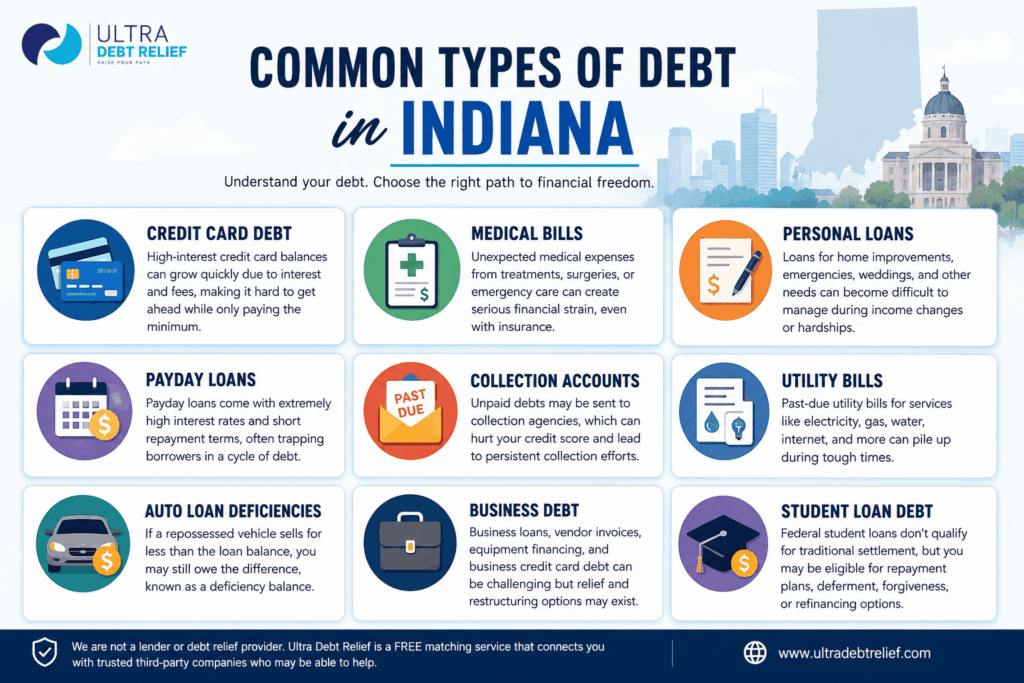
Indiana residents face many different types of financial obligations, and not all debts require the same solution. Understanding the type of debt you have is the first step toward choosing the most effective debt relief program. While some debts can be negotiated or consolidated, others—such as federal student loans or certain tax debts—may require specialized assistance. Below are the most common types of debt for which Indiana residents seek relief.
Credit Card Debt
High-interest credit card balances are one of the leading reasons people seek debt relief. Carrying large balances month after month can make it difficult to pay more than the minimum payment, causing debt to grow due to accumulating interest and fees.
Medical Bills
Unexpected medical expenses from hospital stays, surgeries, emergency care, or ongoing treatments can quickly become overwhelming. Medical debt is a common financial challenge, even for individuals with health insurance.
Personal Loans
Personal loans used for home improvements, emergencies, weddings, or other expenses can become difficult to manage if income changes or unexpected financial hardships arise.
Payday Loans
Payday loans often come with extremely high interest rates and short repayment periods. Many borrowers become trapped in a cycle of renewing or rolling over these loans, making debt relief an important option to explore.
Collection Accounts
When debts remain unpaid for an extended period, creditors may transfer or sell them to collection agencies. Collection accounts can negatively affect your credit score and may lead to increased collection efforts.
Utility Bills
Past-due electricity, gas, water, internet, and other utility bills can accumulate during periods of financial hardship. Some debt relief or financial assistance programs may help borrowers regain control of these essential expenses.
Auto Loan Deficiencies
If a vehicle is repossessed and sold for less than the remaining loan balance, the borrower may still owe the difference, known as a deficiency balance. This remaining debt may qualify for certain debt relief solutions.
Business Debt
Small business owners and self-employed individuals may struggle with business-related debts, including business loans, vendor invoices, equipment financing, and business credit card balances. Specialized repayment or restructuring options may be available depending on the circumstances.
Student Loan Debt
Student loans can create long-term financial obligations for many Indiana residents. While federal student loans generally do not qualify for traditional debt settlement programs, borrowers may be eligible for income-driven repayment plans, deferment, forbearance, forgiveness programs, or refinancing options depending on their loan type and eligibility.
Signs You May Need Debt Relief
The financial challenges that affect everyone can be a source of concern regardless of the cause, such as unexpected medical bills, job losses, reduced income, reduced earnings, or rising costs of living. If your debt is becoming hard to control, it could be time to look into the options for debt relief from a professional. Knowing the warning signs before they become obvious can allow you to act before your financial situation gets more severe.
You’re Only Making Minimum Payments.
If you’re unable to pay the minimum monthly payment on your credit card each month, a substantial part of your monthly payment could be earmarked for interest rather than cutting down your principal balance. This could leave the debt owing for a long time.
Your Credit Card Balances Keep Increasing
Even if you’re paying your bills on time, the increasing balances could indicate that interest costs and purchases are exceeding your ability to pay off your debt.
Collection Agencies Contact You Frequently
If you are receiving a constant stream of emails, phone calls, and letters sent by debt collection agencies, it is a sure sign that your debts are unpaid and could require professional help.
You’re Behind on Multiple Bills
Insufficient payments on loans, credit cards, or medical bills and utility accounts could result in penalties for late payments and increased interest rates, as well as a decline in your score on credit. The fact that you are in debt on several accounts at the same time could indicate the need for an organized debt relief plan.
You’re Using One Credit Card to Pay Another
Relying on a credit card to pay ooff adifferent one can create a cycle of debt that is becoming harder to end. This is usually an indication that your current repayment method is no longer sustainable.
Your Debt Is Causing Daily Stress
If financial stress is affecting your relationships, sleep, or work performance, or general well-being, then your debt could be having an impact on the quality of your life. Finding help early can ease stress both emotionally and financially.
You’re Considering Bankruptcy
If bankruptcy is now one of your main options, it’s worthwhile to explore other options for debt relief. Options like the debt settlement process, consolidation, or debt management programs could be a viable option based on your financial situation.
Your Debt Exceeds Your Ability to Repay
If your monthly debts always exceed what you could manage to afford after paying important living expenses, then it’s an appropriate time to seek out professional advice. The debt reduction program will assist you in evaluating your options and formulating an effective plan to regain financial stability.
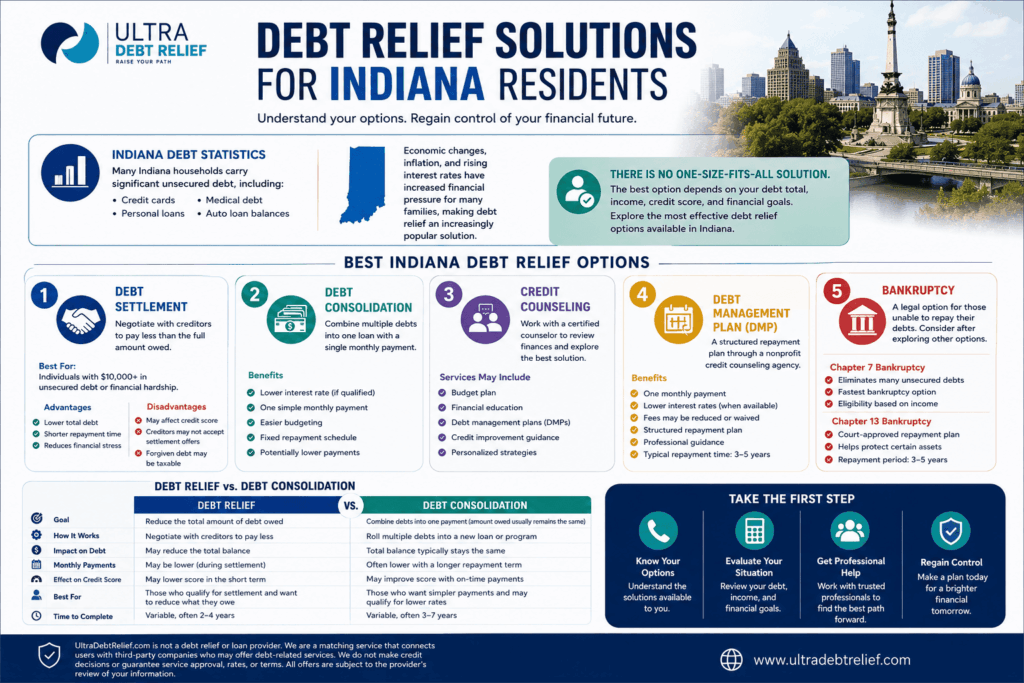
Indiana Debt Statistics
Many Indiana households carry significant unsecured debt, particularly:
- Credit cards
- Medical debt
- Personal loans
- Auto loan balances
Economic changes, inflation, and rising interest rates have increased financial pressure for many families, making debt relief an increasingly popular solution.
Best Indiana Debt Relief Options
If you’re struggling to pay off debt, there’s no one-size-fits-all solution. The most effective debt relief solution depends on factors like your debt total, the amount of income you earn, your credit score, and your financial goals. Below are the most commonly used debt relief options available to Indiana residents and their advantages and drawbacks.
1. Debt Settlement
A debt settlement plan is a method where you or a debt-settling firm negotiates with creditors to reduce the amount that you have to pay. Instead of paying the entire amount, you might be able to settle your debt for a smaller amount with a lump-sum payment or a mutually agreed repayment arrangement.
Example
| Original Debt | Negotiated Settlement | Potential Savings |
|---|---|---|
| $20,000 | $12,000 | $8,000 |
Settlement negotiations usually begin after funds have been put aside in a designated account; however, the outcomes can differ according to the creditor.
Best For
- Individuals who have more than $10,000 in unsecured debt
- People experiencing financial hardship
- Insolvent Borrowers who are in arrears with their payments
- For those looking to stay out of bankruptcy
Advantages
- Can lower the total amount owed
- Can you shorten the timeline for repayment?
- Could help reduce your financial burden overall.
Disadvantages
- This could affect your credit score
- Creditors do not have to accept settlement offers.
- The debt forgiven could be tax-related
2. Debt Consolidation
Debt consolidation consolidates multiple debts into one monthly loan. Instead of managing multiple loans and credit cards that have different rates of interest as well as due dates, you’ll only have one monthly payment to track.
As an example, instead of paying for the six personal credit card and two loans in separate installments, it is possible to consolidate debt to pay one bill per month, usually at a lower rate of interest depending on whether you qualify.
Benefits
- Lower rate of interest (for those who are qualified)
- One simple monthly payment
- Financial management and budgeting are much easier
- Fixed repayment schedule
- The possibility of lower monthly payments
3. Credit Counseling
Credit counseling is provided through certified financial counselors who analyze your financial picture and make recommendations based on your specific needs. The goal of their service is to help you better understand the debt you have, improve your financial management, and select the most effective repayment strategy.
In a session of counseling, they usually review your expenses, income, and outstanding debts and credit history before preparing an individual action plan.
Services May Include
- Budget plan
- Financial education
- Debt management plans (DMPs)
- Credit improvement guidance
- Customized repayment strategies for your needs
4. Debt Management Plan (DMP)
A Debt Management Plan (DMP) is a structured repayment plan typically offered by a nonprofit credit counseling agency. Instead of paying separate installments for each lender, you can make only one payment per month to your agency, which then distributes the funds to your creditors.
The agency could bargain for lower interest rates or eliminate certain fees or simplify your repayment procedure.
Benefits
- One monthly installment
- Lower interest rates (when they are available)
- In certain instances
- Plan for structured repayment
- Professional financial guidance
A typical repayment time: 3 to 5 years
5. Bankruptcy
The bankruptcy process is created to aid those who are in a position to pay their debts. Although it can offer significant economic relief, the process should be considered only after looking at other options for debt relief since it could result in longer-term implications for credit and financial matters.
Chapter 7 Bankruptcy
Chapter 7 permits borrowers who are eligible to pay off a variety of unsecured debt by following an approved court process. It is typically dependent on income as well as an assessment of the means tests in federal law.
Key Features
- Eliminates eligible unsecured debts
- The fastest option for bankruptcy
- Eligibility requirements based on income
Chapter 13 Bankruptcy
Chapter 13 lets individuals restructure their debts under an approved repayment plan by the court, which typically lasts between three and five years. This may allow borrowers to retain certain assets while they catch up on late payments.
Key Features
Can help safeguard some assets against liquidation options.
A repayment plan that has been approved by the court
The repayment period is 3 to 5 years.
Debt Relief vs. Debt Consolidation
| Feature | Debt Relief | Debt Consolidation |
|---|---|---|
| Reduce the debt amount. | Yes. | No |
| Lower interest | Sometimes | Yes. |
| Monthly payment | Lower | Often lower |
| Credit impact | Moderate | Usually less |
| Best for | Financial hardship | Good credit borrowers |
Indiana Debt Relief Eligibility
You may qualify if you:
- Live in Indiana
- Have unsecured debt
- Experience financial hardship
- Have regular income
- Cannot realistically repay your debts
Each provider has different qualification requirements.
Types of Debt That May Qualify
Eligible debts often include:
- Credit cards
- Medical debt
- Personal loans
- Collection accounts
- Store credit cards
- Certain private loans
Usually excluded:
- Federal student loans
- Child support
- Alimony
- Recent tax debt
- Secured mortgages
Benefits of Indiana Debt Relief
Debt relief programs may help you:
- Lower monthly payments
- Reduce total debt
- Stop collection calls
- Avoid lawsuits
- Eliminate financial stress
- Create a structured repayment plan
- Improve long-term financial stability
Potential Risks
Before enrolling, understand possible drawbacks:
- Credit score may temporarily decrease.
- Creditors are not required to negotiate.
- Forgiven debt may have tax consequences.
- Some programs charge fees.
- Results vary by creditor and financial circumstances.
Choose a reputable debt relief provider and review all terms carefully.
How the Indiana Debt Relief Process Works
Beginning a credit relief plan is usually simple. While the exact steps differ from one provider to the next, the majority of programs follow the four steps.
Step 1: Free Financial Evaluation
A debt expert analyzes your financial position, such as your monthly income, expenditures, outstanding debts, and financial goals. This evaluation helps to determine which debt relief options might be the most suitable option for your requirements.
Step 2: Choose the Right Debt Relief Program
Based on your financial analysis, you’ll receive suggestions for the best option, like debt settlement and consolidation of debt and a debt management strategy, or, in some situations, a bankruptcy referral.
Step 3: Begin Your Repayment Plan
After you sign up for the program, you’ll begin making the monthly payments that you agreed to. Based on the plan outstanding,the provider will negotiate with creditors or consolidate debts or handle payment on behalf of you.
Step 4: Become Debt-Free
When you pay your bills and debts are settled and your balances are reduced, the outstanding balances fall. The program’s completion can put you on the right track towards financial stability improvement and debt-free living for the long term.complete. Complete.
Tips to Avoid Future Debt
After completing a debt relief program:
- Build an emergency fund.
- Create a monthly budget.
- Pay bills on time.
- Avoid unnecessary credit card spending.
- Monitor your credit report regularly.
- Save for unexpected expenses.
- Keep credit utilization low.
Why Indiana Residents Choose Professional Debt Relief
Professional debt relief companies can:
- Negotiate with creditors
- Explain available options
- Create customized repayment plans
- Help reduce financial stress
- Provide ongoing support throughout the process
Always research providers, verify credentials, read customer reviews, and understand any fees before enrolling.
Indiana Debt Relief Laws and Regulations
Before enrolling in a debt relief program, it’s important to understand the legal protections available to Indiana consumers.
Consumer Protection Laws
Indiana residents are protected by various federal and state laws that regulate debt collection and debt relief practices.
These protections include:
- Restrictions on abusive debt collection practices
- Requirements for truthful advertising by debt relief companies
- Consumer rights regarding debt validation
- Protection against unfair collection tactics
Before signing any agreement, carefully review the company’s disclosures, fees, and terms.
Indiana Statute of Limitations on Debt
The statute of limitations determines how long a creditor has to file a lawsuit to collect a debt.
| Debt Type | Typical Time Limit* |
|---|---|
| Written Contracts | Up to 6–10 years (depending on the obligation) |
| Promissory Notes | Varies |
| Open Accounts | Depends on the type of account |
Important: The applicable limitation period depends on the facts of your case and may be affected by payments, acknowledgments of debt, or other legal factors. Consult a qualified attorney for legal advice.
Indiana Wage Garnishment Rules
If a creditor obtains a court judgment, wage garnishment may become possible.
Under federal law, garnishment is generally limited to the lesser of:
- 25% of disposable earnings, or
- The amount by which disposable earnings exceed the applicable federal threshold.
Certain debts, such as child support, federal taxes, and student loans, may be subject to different rules.
Indiana Exemption Laws
Indiana law provides exemptions that may protect certain property from creditors, depending on the circumstances.
Protected assets may include:
- A portion of home equity (homestead exemption)
- Qualified retirement accounts
- Certain personal property
- Limited vehicle equity
- Necessary household belongings
The specific protections available depend on Indiana law and the type of legal proceeding.
Indiana Bankruptcy Means Test
Individuals considering Chapter 7 bankruptcy must generally pass the Means Test.
The test evaluates:
- Household income
- Family size
- Monthly expenses
- Disposable income
If you do not qualify for Chapter 7, Chapter 13 bankruptcy may still be an option.
How Debt Relief Affects Your Credit Score
One of the most common concerns is the impact on credit.
| Debt Solution | Credit Score Impact |
|---|---|
| Debt Settlement | Moderate to Significant |
| Debt Consolidation | Low to Moderate |
| Debt Management Plan | Moderate |
| Bankruptcy | Significant |
| Credit Counseling | Minimal |
While some options may temporarily lower your credit score, successfully completing a repayment program and maintaining positive financial habits can help improve your credit over time.
Debt-to-Income (DTI) Ratio
Many lenders use your Debt-to-Income (DTI) ratio to evaluate financial health.
Formula
DTI = (Total Monthly Debt Payments ÷ Gross Monthly Income) × 100
Example
Monthly debt payments: $2,000
Monthly gross income: $5,500
DTI = 36.4%
General Guidelines
| DTI | Interpretation |
|---|---|
| Under 20% | Excellent |
| 20%–35% | Good |
| 36%–49% | High |
| 50% or more | May indicate financial distress |
Reducing your DTI can improve your ability to qualify for loans and lower borrowing costs.
How Creditors Evaluate Settlement Offers
Creditors typically consider several factors before accepting a settlement offer, including:
- Age of the debt
- Payment history
- Financial hardship
- Current income
- Available assets
- Likelihood of repayment
- Collection costs
- Risk of bankruptcy
Providing accurate financial information may strengthen a hardship-based settlement request.
Documents You’ll Need for Debt Relief
Having the right documents ready can speed up the evaluation process.
Typical documents include:
- Government-issued ID
- Proof of income
- Recent bank statements
- Credit card statements
- Loan statements
- Collection notices
- Monthly budget
- Tax returns (if requested)
- Employment verification
How to Choose the Right Indiana Debt Relief Company
When comparing providers, consider the following:
- ✔ Free consultation available
- ✔ Transparent fee structure
- ✔ No guaranteed results claims
- ✔ Experienced debt specialists
- ✔ Strong customer reviews
- ✔ Personalized debt analysis
- ✔ Clear explanation of available options
- ✔ Responsive customer support
Debt Relief Timeline
| Stage | Estimated Time |
|---|---|
| Initial Consultation | 30–60 minutes |
| Financial Review | 1–3 days |
| Program Enrollment | 1–7 days |
| Creditor Negotiations | Several months (varies) |
| Debt Resolution | Depends on the program and debt amount |
Actual timelines vary based on the amount of debt, the selected program, and creditor participation.
Final Thoughts
Debt can feel overwhelming, but it doesn’t have to define your future. Whether you’re dealing with mounting credit card balances, medical bills, personal loans, or other unsecured debts, understanding your debt relief options is the first step toward regaining financial control. Instead of letting debt continue to grow, take action early and explore the solutions available to you. In others city like Debt Relief Programs Florida, Debt Relief Programs Tennessee,
Maryland Student Loan Debt Relief has the same issues related to debt.
If any of the financial warning signs discussed in this guide sound familiar, don’t wait until missed payments, collection calls, lawsuits, or the possibility of bankruptcy make your situation even more challenging. Schedule a debt consultation with a trusted debt relief specialist to understand your options and create a personalized plan before your financial burden becomes more difficult to manage.
From debt settlement and debt consolidation to personalized debt relief solutions, Ultra Debt Relief is committed to helping Indiana residents reduce debt and achieve long-term financial stability. Whether you’re looking for expert guidance or a customized strategy to become debt-free, you can count on our experienced team for honest advice, compassionate support, and solutions tailored to your unique financial situation. Contact Ultra Debt Relief today and take the first step toward a stronger financial future.
FAQ
How can I find out if someone has filed for bankruptcy in Indiana?
To determine if a person declared bankruptcy in Indiana is a matter of searching court records for federal courts, since bankruptcy cases are dealt with at the federal level, rather than at the state levels.
Here are the most common methods to find Indiana bankruptcy cases, as per the U.S. Bankruptcy Court for the Southern District of Indiana and Bymaster Bankruptcy Law Offices
“PACER” (Public Access to Electronic Court Records): This is the primary federal database. Search for court filings, discharge orders, case filings, as well as docket entry entries in both Northern as well as the Southern Districts of Indiana. You will require an account on PACER in order to access these documents.
McVCIS (Voice Case Information System): For an easy and free check, use the McVCIS system that lets you access case information at any time via phone. Contact (866) 822-8029, then follow voice directions to look for filings.
Credit scores and bankruptcy filings are typically listed on a person’s credit report for a period of 7 to 10 years.
National Archives: For earlier Indiana bankruptcy proceedings (generally before 2005), the records could be archived in the National Archives in Chicago.
Indiana is divided into two districts that encompass all the 92 counties (Northern and Southern Districts), and both use the PACER system.
Do you want me to provide a detailed explanation of how to use the PACER system, or do you want me to provide direct hyperlinks to both the Northern and Southern District sites?
Need financial assistance forthe elderlyy in Indiana?
Indiana provides a variety of financial assistance programs for older residents, which include federal and state options. These programs aid with the cost of healthcare, housing expenses, and energy costs.
A few of the most popular programs include Medicaid, Medicare, Supplemental Security Income (SSI), as well as the CHOICE program.
State-Specific Programs:
CHOICE Program:
. Opens in new tab
This program allows seniors who are at risk of needing home care to stay at home or with their caregivers by offering assistance and services.
Home and Community Based Services (HCBS) Medicaid Waivers:
. Opens in new tab
These waivers are for those who require nursing home care but would prefer to remain at home or in their communities.
Federal Programs:
Social Security:
Pays out monthly to pensioners.
Supplemental Security Income (SSI):
Cash payments are made monthly to seniors who are low-income and who have disabilities, to help meet the necessities of life.
Medicare:
Federal health insurance plan for seniors 65 and older that helps with medical expenses.
Medicaid:
Statewide program that provides health insurance for those with low incomes.
Low-Income Home Energy Assistance Program (LIHEAP):
Assistance with utility bills for households with lower incomes.
Weatherization Assistance Program:
Helps to make homes more energy efficient and reduces energy bills.
USDA Housing Repair Loans and Grants:
Help in repairing homes for people with low incomes.
Senior Farmers’ Market Nutrition Program:
Offers coupons to purchase fresh fruits and vegetables at the farmers’ market.
Commodity Supplemental Food Program:
Food assistance for those with low incomes.
Other Resources:
State Assistive Technology Programs:
It can help seniors access equipment and devices needed to live independently.
Housing Choice Vouchers:
Helps families and people with low incomes afford housing.
State Property Tax Relief Programs:
Could offer reductions in property taxes or exemptions for senior citizens.
Family Caregiver Support:
Help and resources are available to family caregivers.
Program for All-Inclusive Care for the Elderly (PACE):
Provides a complete and coordinated program of care for older adults.
EBT Card Security:
Indiana is now equipped with the EBT credit card that lets cardholders secure and lock their card to provide additional security.
What are the key laws regarding debt collection in Indiana?
Collection of debts in Indiana is subject to a combination of federal and state-specific laws designed to safeguard consumers from unfair or misleading practices. Important regulations include the requirement of licensing of agencies, specific statutes of limitation for lawsuits, as well as strict restrictions on harassment.
Here are the main lawful requirements for collections of debts in Indiana:
1. Licensure and Regulation
Secretary of State Registration Companies that collect in Indiana must be registered with the Indiana Secretary of State, Securities Division. Indiana Secretary of State’s Securities Division.
NMLS Registration: All filings and fees associated with registration are dealt with by NMLS. Nationwide Multistate Licensing System (NMLS).
2. Federal Protection (FDCPA)
Fair Debt Collection Practices Act (FDCPA): This law, which is federal in nature, applies to Indiana and limits the ways collectors behave. It bans harassment, false claims, and unjust practices.
“Debt Collector” Definition: Recent Indiana court rulings have confirmed that “passive” debt buyers, who buy defaulted loans (such as loans for students) and contract with agencies to take them back, are regarded as debt collectors under both the FDCPA and Indiana laws.
3. Statute of Limitations (Time Limits)
The period of time to file a suit to recover debt varies based on the kind of contract:
Written contracts: Generally, lawsuits are required to be filed in the first six months.
Opening Accounts (e.g. Credit Card): Usually six years.
Additional Debts A few debts might be subject to a two-year limitation, in particular for certain types of accounts open.
4. Prohibited Collector Behavior
Both under federal and state law In Indiana, debt collectors are not able to: Indiana are not able to:
Make you feel threatening: This includes using vulgar language or a threat of violence.
Time of call: Calling before 8:00 AM or after 9:00 pm.
Fraud you: Falsely claiming to be law enforcement or attorneys or omitting the amount due.
Unfair practices: Including attempting to take more money than what is owed, or by calling by post.
Unlawful Threats The threat to garnish wages or take property without legal authority.
5. Legal Action (Small Claims)
Small Claims Court: Creditors typically utilize Indiana small claims courts to collect on debts.
Method: Debtors may receive demand letters, which can lead to court proceedings and possibly judgments that allow for the garnishment of wages or a property lien.
If you’re dealing with the debt collection agency, it is highly advised to be aware of your rights under these rules.
If you’re looking to learn more about a particular aspect of these laws, I’m able assist in the. For instance, do you wish to learn what is the time limit for a particular kind of debt, or the best way you can stop debt collection agencies from calling you is?
What are the best payday loan options in Evansville?
If you’re in need of cash urgently in Evansville, payday loans are readily available, but they should typically be thought of as a last resort because due to their extremely high charges and sluggish repayment terms. A lot of payday loans have APRs of more than 300%, which makes it simple to slip into the cycle of repeated borrowing.
In the capacity of an UltraDebtRelief expert, we have a few alternatives we would recommend according to this sequence:
Small personal loans: Banks and lending institutions in your area might provide installment loans that have low rates, and with fixed monthly payments, in comparison to payday loans.
Credit Union Emergency Loans (PALs) – If you’re a member of a credit union, the Payday Alternative Loans (PALs) offer low-cost short-term loans with less interest than conventional payday loans.
Credit Extensions If you’re taking out a loan to pay for utilities, rent or medical bills, make contact with the service provider first. A lot of lenders offer payment plans that could reduce the requirement for a payday loan.
Counseling for Debt Relief If you’re relying on payday loans to pay off an ongoing debt, it could suggest a more serious financial problem. A specialist in debt relief will help you consider options like consolidating debt or settling debt prior to when expenses increase.
When a Payday Loan Might Make Sense
A payday loan is only considered if:
It’s a real emergency.
You are able to repay the entire amount at the time of your next payday.
You’ve exhausted lower-cost alternatives.
At UltraDebtRelief, we urge customers from Evansville to evaluate all of the available options prior to deciding on a payday loan. If you’re struggling with many high-interest loans or making use of short-term loans, our company can connect you to experts in debt relief that can offer sustainable solutions to ensure your financial stability for the long run.